
PUFFINS IN ICELAND: SUMMER ON THE CLIFFS, THEN GONE AT SEA

Few birds are as instantly recognisable as the Atlantic puffin (Fratercula arctica). With its brightly coloured bill, black-and-white plumage and almost comically expressive face, it has become one of Iceland’s most familiar natural symbols. Often nicknamed the “parrot of the sea” or the “clown of the North”, the puffin is a favourite with photographers and visitors from around the world.

But there is something slightly misleading about its celebrity status. For most of the year, puffins are nowhere near Iceland’s cliffs, coastlines or camera lenses. They spend their lives far out on the open sea, returning to land for just one reason: to breed.
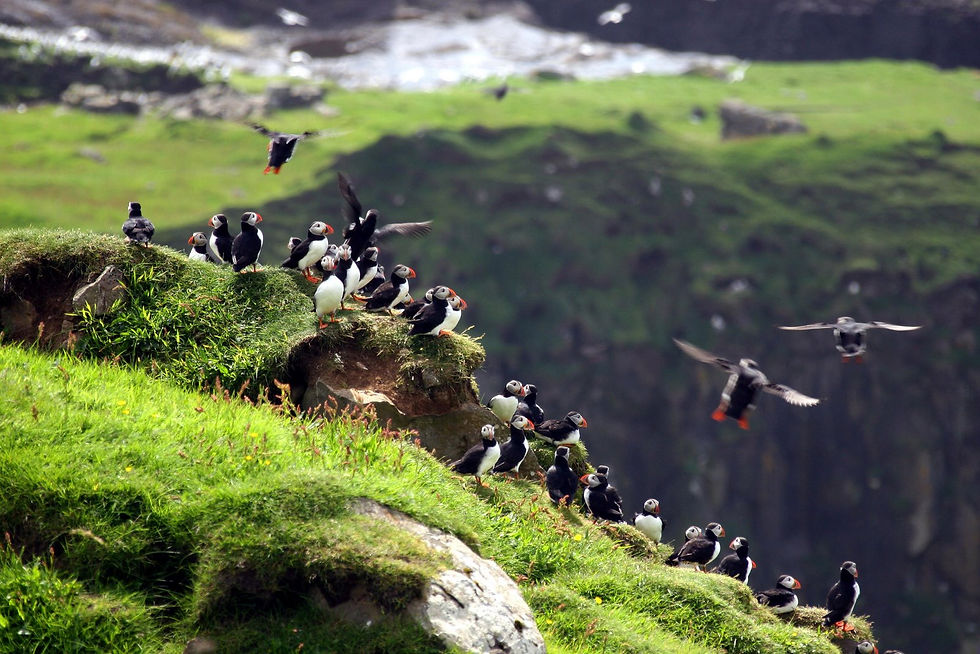
Iceland is one of the most important breeding grounds for Atlantic puffins anywhere in the world. During the short Arctic summer, vast numbers arrive along the coast, turning grassy headlands and offshore islands into some of the best places to observe these remarkable seabirds.
When do puffins arrive in Iceland?
The first puffins usually return to Iceland in late April or early May. Their arrival marks the beginning of the breeding season, when birds come ashore to reclaim nesting sites and prepare their burrows.
They remain on land through the summer, generally until mid-August. Some colonies may still be active towards the end of the month, and a few birds can linger into early September. The timing varies from year to year, depending on weather and conditions at sea.
For visitors, June and July are usually the best months to see puffins in Iceland. By then, the colonies are busy, adults are constantly flying between the sea and their nests, and the birds are often visible at remarkably close range.
Puffin activity can be particularly noticeable in the morning and again later in the afternoon or evening. As with all wildlife watching, however, there are no guarantees. Weather, tides and the availability of food all influence how active the birds are.
Once the breeding season is over, the cliffs become quiet again. Most puffins leave Iceland during August, returning to the open Atlantic, where they will spend the coming months.

Life beneath the grass
At first glance, a puffin perched on a grassy cliff edge looks almost too charming to be real. Its comical appearance, however, conceals the remarkable adaptations of a bird that spends most of its life at sea.
Unlike many seabirds, puffins do not usually build their nests on exposed ledges. Instead, they dig burrows into grassy slopes and the tops of cliffs, sometimes making use of natural cavities in the ground. A burrow can extend more than a metre underground, providing shelter for the egg and, later, the chick.
The female usually lays a single egg. Both parents take part in incubation and the care of their offspring. After approximately six weeks, the chick hatches and is fed by its parents, which bring back small fish from the sea.
Puffins are remarkably efficient hunters. They dive beneath the surface and use their wings to propel themselves through the water, almost as if they were flying underwater. Their bills are specially adapted to hold several fish at once, carried crosswise rather than one after another. This allows an adult to bring a substantial meal back to its hungry chick in a single trip.
The contrast between the bird on land and the bird at sea is striking. On the cliffs, puffins can appear clumsy and almost theatrical. Underwater, they are agile and accomplished hunters.
The first journey of a puffling
A young puffin is known as a puffling. Its departure from the nest is one of the most remarkable moments in the breeding season.
When it is ready to leave, the young bird emerges from its burrow on its own, usually under cover of darkness. Its parents do not escort it or show it the way. Instead, the puffling relies on instinct as it makes its first journey towards the sea.
Some young birds flutter or glide down the grassy slopes, eventually reaching the water below. From that moment on, they must learn to swim, dive and find food for themselves.
The journey is not always straightforward. In the Westman Islands, August brings a rather unusual form of wildlife rescue. Young puffins can become disoriented by the artificial lights of Heimaey, the islands’ main town. Instead of heading towards the sea, they sometimes fly into streets and other built-up areas.
Local residents organise so-called puffin patrols. They collect the confused young birds and help them make their way back to the water. It is a tradition that has become an integral part of life in the Westman Islands, where the puffin is far more than a seasonal attraction.
Where to see puffins in Iceland
Iceland offers several outstanding places to observe puffins. Some are home to enormous breeding colonies, while others are particularly convenient for visitors who want to watch the birds at close range.
The Westman Islands
Vestmannaeyjar, or the Westman Islands, are among Iceland’s most important puffin breeding areas. The main island, Heimaey, is surrounded by steep cliffs and grassy slopes where large numbers of birds nest during the summer.
The islands can be reached by ferry from Landeyjahöfn on the south coast or by air from Reykjavík. During the breeding season, puffins are a familiar sight around the cliffs, and their presence is deeply woven into local life.
The Westman Islands are also the setting for the August puffin patrols, when residents help young birds that have become confused by the town’s lights.
Látrabjarg
Látrabjarg in the Westfjords, is one of the most spectacular seabird cliffs in Europe. Stretching for kilometres along Iceland’s westernmost edge, it provides nesting habitat for huge numbers of seabirds, including Atlantic puffins.
The birds can sometimes be observed at surprisingly close range. But visitors should remember that the ground is not always as solid as it looks. Puffins dig their burrows into the grassy surface, and parts of the cliff edge can be undermined. Approaching too close to the edge can therefore be dangerous, both for people and for the birds.
Borgarfjörður Eystri and Hafnarhólmi
In eastern Iceland, the small harbour at Hafnarhólmi, near Borgarfjörður Eystri, is one of the most accessible places to watch puffins.
Wooden platforms and viewing areas allow visitors to observe the birds without having to approach the nesting ground itself. Thousands of breeding pairs gather here each summer, making it an excellent destination for photographers and anyone hoping to see puffins at close range.
Dyrhólaey
The headland of Dyrhólaey, near Vík on Iceland’s south coast, is another well-known puffin-watching location. Its cliffs and grassy slopes provide nesting sites, and during the breeding season the birds can often be seen flying between the land and the sea.
I have a particularly memorable experience from Dyrhólaey. One puffin wandered close to my camera equipment and eventually settled on my cap. The other birds seemed remarkably unconcerned by my presence.

Such encounters can make wildlife photography unforgettable, but they should never be treated as an invitation to approach or disturb the birds. Puffins need space, especially around their nesting burrows. The best photograph is never worth putting a bird or its young at risk.


Other places to look
Puffins also breed on islands in Breiðafjörður Bay, on Grímsey north of the Arctic Circle and on several smaller islands off Iceland’s northern coast. The exact opportunities vary from one location to another, but during the breeding season there are many places where visitors can encounter these seabirds.
Those travelling from Reykjavík can also consider boat trips into Faxaflói Bay. Some excursions visit the small islands of Akurey or Lundey, where puffins nest during the summer.
Puffins beyond Iceland: the Faroe Islands and Brittany
Iceland may be one of the best places in the world to see Atlantic puffins, but it is by no means the only one. The species breeds across the North Atlantic, including in the Faroe Islands, where I have also had the opportunity to photograph these birds.
One of the most memorable locations is Mykines, an island known for its seabird colonies and dramatic coastal scenery. Puffins are an integral part of the island’s summer landscape, although access to nesting areas is subject to local rules designed to protect the wildlife.
Further south, the species reaches one of its southernmost European breeding areas in France. The islands of the Sept-Îles archipelago, off the coast of Brittany in the Côtes-d’Armor department, are home to the last significant puffin colony in the country.
The birds are generally present from mid-March until mid-July. The colony is small compared with those in Iceland, but it is an important remnant of a once more widespread population. Boat trips offer an opportunity to see the islands and their seabirds, although landing is restricted in order to protect nesting birds.
Why puffins are under pressure
Despite their popularity, Atlantic puffins face growing challenges. Their populations have declined in several parts of the North Atlantic over recent decades, and the species is classified as Vulnerable globally by the International Union for Conservation of Nature (IUCN).
One of the major pressures comes from changes in the marine environment. Puffins depend on small fish, including capelin, to feed themselves and their chicks. As sea temperatures and marine ecosystems change, the availability and distribution of these fish can shift. That can make it harder for adult birds to find enough food during the breeding season.
Hunting has also been part of the history of some North Atlantic communities, including Iceland. Puffin meat is still served in a few places, although the species is now better known internationally as a symbol of the region’s wildlife.
Puffins are long-lived birds, but they generally raise only one chick a year. That means a decline in breeding success can have long-lasting consequences. Even when conditions improve, populations may take time to recover.
The future of these birds is closely connected to the health of the North Atlantic. Protecting nesting colonies is important, but so is understanding what is happening in the waters on which puffins depend for most of their lives.

The puffin: a summer visitor, a bird of the open sea
For a few months each year, puffins become part of Iceland’s visible landscape. They occupy the cliffs, circle above the water and return repeatedly to their burrows with fish in their bills. Visitors arrive in their thousands to photograph them, and their unmistakable faces appear on postcards, souvenirs and travel websites.
Then, almost as suddenly as they arrived, they are gone.
The cliffs fall quiet, the burrows are left behind and the puffins return to a life spent far out on the Atlantic. It is a useful reminder that what visitors see during an Icelandic summer is only a brief glimpse of a much larger natural world.
The puffin is not simply an Icelandic bird. It belongs to the North Atlantic, from the Faroe Islands to the coast of Brittany. But wherever it breeds, its life remains largely hidden from human eyes — out on the open sea, far from the cliffs where it becomes a star of the summer.
Puffins in Iceland: frequently asked questions
Question | Answer |
When do puffins arrive in Iceland? | Most return in late April or early May, although the timing varies with conditions. |
When is the best time to see puffins in Iceland? | June and July are generally the best months, when the breeding colonies are active. |
When do puffins leave Iceland? | Most depart in August. Some may remain until late August or early September. |
Where are the largest puffin colonies in Iceland? | The Westman Islands, Látrabjarg in the Westfjords and Borgarfjörður Eystri are among the best-known breeding areas. |
Where can I see puffins at close range? | Hafnarhólmi, near Borgarfjörður Eystri, has viewing platforms that make observation particularly convenient. |
Can I see puffins near Reykjavík? | Yes. Some boat trips into Faxaflói Bay visit Akurey or Lundey, where puffins nest in summer. |
Can puffins be seen in Iceland all year round? | No. They come ashore to breed during the summer and spend the rest of the year at sea. |
What time of day is best for puffin watching? | They can be seen throughout the day, but activity is often particularly noticeable in the morning and later in the afternoon or evening. Weather and feeding conditions also matter. |
Can visitors see puffin chicks? | The best chance is during the summer, especially in July and August. Young puffins leave their burrows at night, so they are not always easy to spot. |
Where do puffins go in winter? | They spend the winter months out on the open North Atlantic, away from their breeding colonies. |
A note on timing: Puffin arrival and departure dates are approximate. They can vary between colonies and from one year to another, depending on weather, sea conditions and the availability of food.

About the Author
Iceland has fascinated me for many years. Over the course of numerous journeys across the island, I have driven tens of thousands of kilometers, experienced storms that changed travel plans within minutes, and witnessed days when choosing the right route meant discovering places that most visitors never see. I documented many of these experiences in my documentary film Island in the North.
Through this website, I share practical travel advice, up-to-date information, and firsthand experiences from the field to help others explore Iceland more safely and gain a deeper understanding of its unique landscapes and ever-changing nature.


Komentáře