
ICELAND 2026: FREQUENTLY ASKED QUESTIONS ABOUT THE TOTAL SOLAR ECLIPSE (FAQ)

On August 12, 2026, Iceland will become one of the best places in the world to observe a total solar eclipse. This extraordinary astronomical event is expected to attract tens of thousands of visitors to the island. We have prepared answers to the most frequently asked questions about the 2026 solar eclipse in Iceland.

When will the total solar eclipse occur in Iceland?
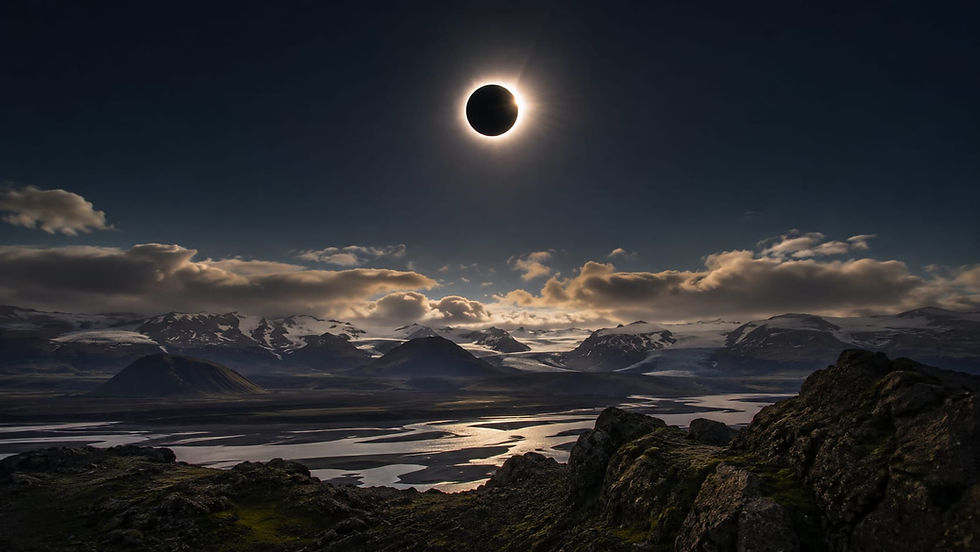
The total solar eclipse will be visible in Iceland on August 12, 2026. During the event, the Moon will completely cover the Sun's disk, turning daylight into twilight for a few minutes.
Eclipse Phase | Time (Iceland local time, GMT/UTC) |
Partial eclipse begins | 16:47 |
Total eclipse begins | 17:48 |
Maximum eclipse | 17:48:46 |
Total eclipse ends | 17:49 |
Partial eclipse ends | 18:47 |
Will the eclipse be visible from all of Iceland?
The partial eclipse will be visible throughout Iceland. However, the total eclipse will only be visible within the path of totality, which crosses a large portion of the country.
Outside the path of totality, the Sun will remain only partially covered, although the eclipse will still be very impressive.
How long will the total eclipse last?
The duration of totality will vary depending on the viewing location, ranging from several tens of seconds to a few minutes. The exact duration depends on where you are positioned within the path of totality.
In areas close to the centerline of the path, totality may exceed two minutes, while locations near the edges of the path will experience a shorter total phase.
Is Reykjavík within the path of totality?
Yes. Reykjavík is among the major locations from which the total solar eclipse can be observed.
Do I need special eclipse glasses?
Yes. During the partial phases of the eclipse, certified solar viewing glasses must be used. The eclipse can only be viewed safely without eye protection during the brief period of totality.
How do I know when I can remove my eclipse glasses?
Eclipse glasses can be safely removed only during totality, when the Sun's disk is completely covered by the Moon. As soon as even a tiny portion of the Sun becomes visible again, eye protection must be put back on immediately.
A practical indication is when the last bright crescent of sunlight disappears and the landscape suddenly darkens into twilight. At the end of totality, be prepared to put your glasses back on as soon as the first rays of sunlight reappear, creating the famous "diamond ring" effect.
What if it is cloudy?
Icelandic weather is highly variable. Even with cloud cover, the eclipse may still be visible through breaks in the clouds.
Weather forecasts can change significantly throughout the day, so many visitors plan to remain mobile and relocate to areas with the best expected conditions on eclipse day.

Where are the best places to watch the eclipse?
Popular viewing locations include Reykjavík, the Snæfellsnes Peninsula, the Westfjords, and other regions located within the path of totality.
The ideal viewing location will depend not only on the duration of totality but also on weather conditions, parking availability, and expected visitor numbers.
Should I book accommodation well in advance?
Yes. Extremely high demand for accommodation is expected throughout Iceland, especially within the path of totality.
Many hotels, guesthouses, campsites, and rental properties are booked months or even more than a year in advance.
Will there be many tourists in Iceland during the eclipse?
Yes. The eclipse is expected to generate one of the largest tourism surges in modern Icelandic history.
Could there be traffic problems during the eclipse?
Yes. Significantly increased traffic is expected, particularly in areas located within the path of totality.
Roads leading to popular viewing locations may become congested, and traffic jams are likely after the eclipse ends. Visitors are advised to arrive early, prepare alternative routes, and expect return journeys to take considerably longer than usual.
Parking and access to services may also be limited in some locations.
Should I rent a car?
If you want the flexibility to respond to changing weather conditions and move to areas with clearer skies, renting a car is highly recommended.
Mobility may be the deciding factor between viewing the eclipse under clear skies or beneath thick cloud cover.

What weather can I expect in August?
August is generally one of the most pleasant months to visit Iceland. Temperatures typically range from 8°C to 15°C (46–59°F), although conditions can change rapidly and unexpectedly.
Can I photograph the eclipse with a smartphone?
Yes, but the best results are usually achieved with a camera equipped with optical zoom and an appropriate solar filter.
When photographing the Sun, it is important to protect both your eyes and your equipment.
Do I need a solar filter for my camera?
Yes. A high-quality solar filter is essential during all partial phases of the eclipse.
For example, you can use a solar filter film similar to the Baader Solar Filter Film:
How long will the entire event last?
From the first contact of the Moon with the Sun until the end of the eclipse, the event will last approximately two to three hours.
Is it worth traveling to Iceland just for the eclipse?
For many people, absolutely.
Iceland offers not only the opportunity to witness one of nature's most spectacular astronomical events, but also world-famous waterfalls, volcanoes, glaciers, black sand beaches, and dramatic landscapes.
Can I also see the Northern Lights during my trip?
Possibly, but nights in mid-August are still relatively bright.
The chances of seeing the Northern Lights increase as summer progresses toward autumn and the nights become darker.
When should I arrive in Iceland?
It is recommended to arrive at least a few days before the eclipse.
This provides greater flexibility when choosing a viewing location and offers a buffer in case of transportation delays or weather-related changes.
Is it safe to watch the eclipse without eye protection?
Only during totality.
At all other times, proper eye protection is essential to prevent serious eye damage.
Will another total solar eclipse occur in Iceland soon?
No. A similarly favorable opportunity will not return to Iceland for many decades.
Why is a total solar eclipse so special?
A total solar eclipse is one of the rarest and most awe-inspiring natural phenomena.
For a few minutes, daylight fades into darkness, the Sun's corona becomes visible, temperatures may drop, and the landscape takes on an almost otherworldly atmosphere. It is an experience that many observers remember for the rest of their lives.

About the Author
Iceland has fascinated me for many years. Over the course of numerous journeys across the island, I have driven tens of thousands of kilometers, experienced storms that changed travel plans within minutes, and witnessed days when choosing the right route meant discovering places that most visitors never see. I documented many of these experiences in my documentary film Island in the North.
Through this website, I share practical travel advice, up-to-date information, and firsthand experiences from the field to help others explore Iceland more safely and gain a deeper understanding of its unique landscapes and ever-changing nature.


Komentáře