
ICELAND SOLAR ECLIPSE 2026: SOLD-OUT HOTELS, NASA SCIENTISTS AND AN ECLIPSE FESTIVAL

The Iceland solar eclipse 2026 will take place on Wednesday, August 12. The country is preparing for an extraordinary influx of visitors that will put pressure on roads, accommodation and other infrastructure. In some parts of Iceland, hotels have been sold out for more than two years, while some of the most attractive viewing locations will be inaccessible by private car during the eclipse. Snæfellsnes will welcome thousands of people to a five-day Eclipse Festival.

Iceland is putting the finishing touches to preparations for one of the biggest tourism and logistical events of the year. The total solar eclipse on August 12, 2026, is expected to bring a huge number of visitors to the country, and authorities have been preparing measures well in advance to prevent traffic chaos and ensure public safety.
Civil protection authorities, police, municipalities, transport authorities and regional tourism organizations are all involved in the preparations. The Icelandic government has established a central coordination system for the eclipse, focusing particularly on traffic, infrastructure, natural sites and the capacity of emergency services.
And the closer August 12 gets, the more specific the measures are becoming.
🌑 NOT IN ICELAND? WATCH THE ECLIPSE LIVE
Iceland Eclipse: An Eclipse Festival Beneath Snæfellsjökull
The total solar eclipse will also provide the backdrop for Iceland Eclipse, a multi-day international festival in and around Hellissandur on the Snæfellsnes Peninsula. From August 11 to 15, 2026, the festival will combine music, art, science, wellness and the exploration of Icelandic nature. The organizers have prepared a program for up to 3,333 visitors, who will be able to watch the total eclipse directly from within the path of totality on August 12. The festival was created by the team behind Secret Solstice and Texas Eclipse, with the nearby Snæfellsjökull glacier adding to the atmosphere.

Tents and a stage for thousands of people are taking shape on Snæfellsnes. Source: Facebook/Iceland Eclipse

Tents and a stage for thousands of people are taking shape on Snæfellsnes. Source: Facebook/Iceland Eclipse

Tents and a stage for thousands of people are taking shape on Snæfellsnes. Source: Facebook/Iceland Eclipse
Dozens of Scientists Are Heading to Iceland. The Eclipse Will Be a Huge Laboratory for Them
The total solar eclipse will be far more than a spectacle for tourists in Iceland. In August, almost 40 scientists involved in NASA research projects will head to the country to use the few minutes of darkness to study phenomena that cannot be observed in quite the same way under normal conditions.
Scientific balloons, for example, will be deployed over Iceland to measure changes in the atmosphere before, during and after the eclipse. Two teams in Iceland plan to launch a total of 80 balloons, with measurements beginning as early as 18 hours before the eclipse and continuing for up to eight hours afterward.
The scientists will focus particularly on how the sudden cooling and darkness affect the planetary boundary layer, the lowest part of Earth's atmosphere.
Another part of the research will take place high above the ground. A NASA WB-57 aircraft will climb to an altitude of around 15 kilometers (50,000 feet) and observe the solar corona, the Sun's outer atmosphere, from above. While people on the ground will experience only several dozen seconds of total darkness, scientists will be trying to extract as much data as possible from this brief event.

Hotels in the Westfjords Were Sold Out Two Years in Advance
One of the biggest challenges is accommodation.
In the Westfjords, where the longest period of totality in Iceland will be visible, most hotels and guesthouses have been fully booked for a long time, according to the regional tourism organization.

In many cases, rooms were booked more than two years in advance.
A similar situation exists in western Iceland, including the Snæfellsnes area. According to Visit West Iceland, hotels and guesthouses there are also largely sold out for the eclipse period, with reservations being made exceptionally far in advance.
For visitors, campsites therefore remain an important option. But even they come with their own challenges. Many campsites in the Westfjords and western Iceland do not use reservation systems and operate on a first-come, first-served basis.
Anyone who wants to be sure of getting a place therefore needs to arrive early.
Reykjavík Faces a Different Kind of Problem
The capital has a huge advantage over the remote parts of the Westfjords in terms of hotels, restaurants, public transportation and other services.

However, Reykjavík is also expecting significantly heavier traffic than usual. Official tourism information therefore recommends that visitors leave their cars parked whenever possible and use city buses, walk or cycle instead. Parking will be limited, and roads around some official viewing locations will be closed during the afternoon.
You Will Not Be Able to Drive Up Bolafjall
One of the most significant measures concerns Bolafjall Mountain above Bolungarvík.
The access road to the summit will be closed to regular car traffic during the eclipse. Visitors will only be able to reach the summit by shuttle bus, with parking available near the departure point.
The reason is simple: the narrow road and exposed summit would not be able to safely accommodate the expected number of private vehicles.
Bolafjall is nevertheless one of the most attractive locations for watching the eclipse, with totality lasting approximately 1 minute and 39 seconds.
Some Roads Will Become One-Way
Further restrictions are planned in the southern Westfjords.
The Örlygshafnarvegur (Route 612) and Rauðasandsvegur (Route 614) will operate under a temporary one-way traffic system from 12:00 noon on August 12. Once the eclipse is over, traffic will be directed back along the same routes.
Authorities also warn that visitor numbers, parking or access may be restricted in other locations depending on the situation.
One rule is repeated practically everywhere:
Do not park on the roadside and do not block access for emergency services.
Maps showing traffic management in different parts of the Westfjords
Snæfellsnes – Official traffic management map published by Vegagerðin for the total solar eclipse on Westfjords (Patreksfjörður–Látrabjarg area) – Official traffic management map published by Vegagerði Dalabyggð – Official traffic management map published by Vegagerðin for the total solar eclipse on 1 Vatnsleysuströnd – Official traffic management map published by Vegagerðin for the total solar eclip Miðnes (Keflavík–Garður–Sandgerði–Hafnir) – Official traffic management map published by Vegagerðin
Source: https://www.vegagerdin.is/
Iceland Advises: Arrive Early and Do Not Rush Away After the Eclipse
Traffic could be the biggest problem of the entire day.
Authorities expect particularly high concentrations of people in the Westfjords, western Iceland, Snæfellsnes and Reykjanes. The government's coordination group has warned, for example, of potentially heavy traffic in western Iceland and congestion around the Hvalfjörður Tunnel and the bridge over Borgarfjörður.
The official advice is therefore surprisingly simple:
Arrive early. And stay where you are for a while after the eclipse.
If thousands of people try to leave in the same direction immediately after totality ends, roads can quickly become congested. Visit Westfjords is therefore directly encouraging visitors not to rush away after the eclipse.
Why Are Authorities Advising People to Stay as Close to Home as Possible?
Iceland's main goal is to prevent unnecessary movement between regions.
The government's coordination group is encouraging residents of western and southwestern Iceland, wherever possible, to watch the eclipse from their homes or as close to home as possible.
The reason is not only traffic. Moving large numbers of people also puts pressure on parking capacity, emergency services, natural sites and other infrastructure.
For tourists, this means something different: if they are already in Iceland, they should choose their viewing location in advance and plan their entire journey around it.
Iceland Is Even Strengthening Mobile Networks
The influx of visitors may be so large that authorities are dealing with something that might not seem connected to an eclipse at all: mobile network capacity.
Iceland's Ministry of Infrastructure has provided special support to strengthen mobile coverage and capacity in the Látrabjarg area, where a large number of visitors are expected.
Mobile operators are also preparing measures in Snæfellsnes, western Iceland and Reykjanes.
Látrabjarg is one of the locations where totality will last the longest on the Icelandic mainland. But the area is remote and its infrastructure is limited.
Better to Choose a Town Than a Remote Road
Icelandic authorities and Visit Westfjords are therefore recommending that visitors use official viewing locations in towns and villages.
Compared with remote locations, these have one major advantage: parking, toilets, refreshments, fuel, better mobile coverage and, most importantly, faster access to help if something goes wrong.
In the Westfjords, recommended locations include Bolungarvík, Ísafjörður, Flateyri, Suðureyri, Þingeyri, Bíldudalur and Hólmavík.
Totality may be slightly shorter at some of these locations than in the most remote areas, but the difference may be more than compensated for by significantly easier logistics.
Iceland Solar Eclipse 2026: And Then the Eclipse Arrives
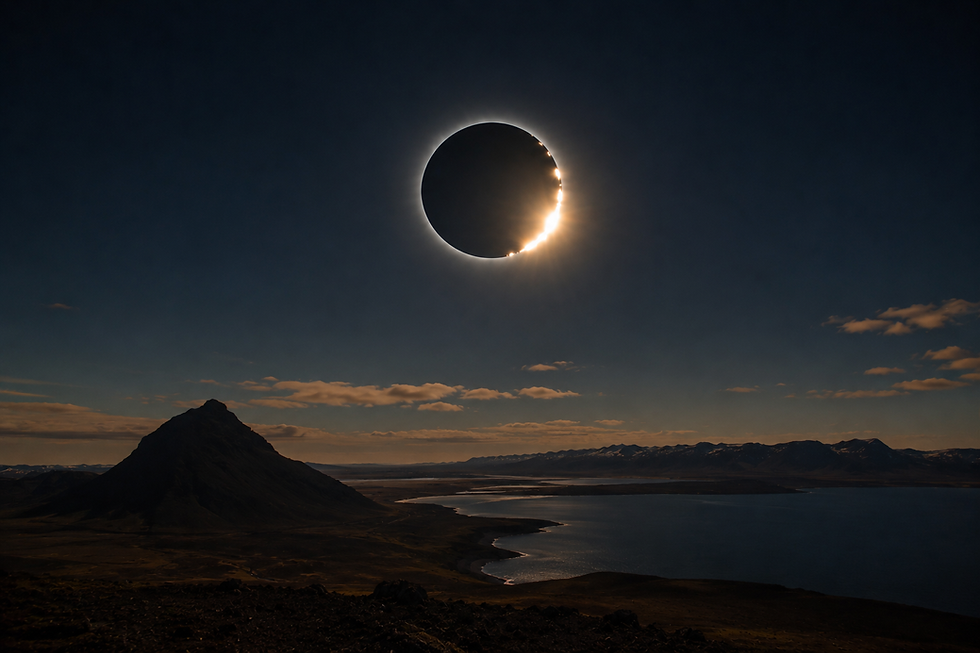
On Wednesday, August 12, 2026, the Moon will pass directly between Earth and the Sun, and its shadow will sweep across western Iceland.
Depending on the location, totality will last from approximately one minute in Reykjavík to more than two minutes in the westernmost parts of the country. At Látrabjarg, totality may last approximately 2 minutes and 13 seconds.
In Reykjavík, totality will begin at approximately 5:48 p.m. local time and last just over one minute.
For Iceland, this is an extraordinary event. A total solar eclipse will be visible from Icelandic territory for the first time since 1954, while Reykjavík will experience a total eclipse for the first time since 1433.

About the Author
Iceland has fascinated me for many years. Over the course of numerous journeys across the island, I have driven tens of thousands of kilometers, experienced storms that changed travel plans within minutes, and witnessed days when choosing the right route meant discovering places that most visitors never see. I documented many of these experiences in my documentary film Island in the North.
Through this website, I share practical travel advice, up-to-date information, and firsthand experiences from the field to help others explore Iceland more safely and gain a deeper understanding of its unique landscapes and ever-changing nature.


Komentáře