
IS ICELAND STILL SAFE? THE COUNTRY WHERE PEOPLE USED TO LEAVE THEIR DOORS UNLOCKED. THEN THE WORLD CAUGHT UP.

When people think of Iceland, they usually picture glaciers, volcanoes, the Northern Lights, and above all, safety. It was a country where cars were often left unlocked, keys stayed in the ignition, and many homes didn't even need locked doors.
Many Icelanders—and countless visitors—still remember the days when renting a car was as simple as receiving a text message telling you where it was parked and where to find the keys. Today, that carefree way of life has largely become a nostalgic memory.

Iceland remains one of the safest countries in the world. But like every modern society, it has gradually changed.
When the Keys Were Waiting in the Ignition
I'll never forget my first solo trip to Iceland. I didn't collect my rental car at an airport counter or spend time signing piles of paperwork.

Before I even boarded my flight, I received a text message with the exact parking location, the car's registration number, and one simple instruction: the keys are in the ignition.
You simply walked to the car, got in, and drove away. Returning it was just as easy.
This system remained common until around 2010.
Today, such a handover is much rarer, but only a few years ago it was perfectly normal in Iceland. It reflected the extraordinary level of trust on which Icelandic society had long been built.
One of the Safest Countries on Earth
For many years, Iceland has consistently ranked among the world's most peaceful nations. International safety and peace indexes regularly place it at the very top.
The reason isn't just low crime.
Icelandic society is small, relatively homogeneous, and built on an exceptional level of trust between people. With a population of roughly 400,000, the country still experiences far less crime than most European nations.
Murders are exceptionally rare. Some years pass without a single homicide, while in others only a handful occur. Because of Iceland's small population, even one incident can noticeably affect national crime statistics.
The country's prison system is equally modest. Iceland's prisons are small, and the total prison population numbers only a few hundred inmates.

"Why Would Anyone Steal It? It's Mine."
Another journey left an even stronger impression.
A friend and I got our car stuck in deep sand on a beach. Before long, a local farmer stopped with his tractor and a small trailer. He happily offered to pull us out but explained that he first needed to fetch a chain from his workshop. He asked us to ride with him.
Before leaving, he placed several diesel fuel cans beside the road so there would be room for us on the trailer.
My friend looked at him in surprise.
"You're just leaving them here? Someone will steal them."
"Why?" he asked.
"Because people steal things."
The farmer looked genuinely puzzled.
"But why would anyone do that? They're mine."
There was no irony in his voice, nor any naïveté. The very idea of someone taking another person's belongings simply seemed foreign to him.
In his world, people didn't take what wasn't theirs.
What Crime Actually Exists in Iceland?
The image of Iceland as a country without crime is no longer entirely accurate. Today, the police most commonly deal with the following:
Petty Theft
Most everyday crime consists of property offences, such as stolen bicycles, electronics, or break-ins to parked cars. These incidents are most common in Reykjavík and in areas with large numbers of tourists.
As tourism has grown, so has the nature of crime. Offences that were once almost unheard of have become a more regular part of police work, particularly thefts at popular tourist attractions.
Violence: Mostly Alcohol-Related and Domestic
Violent crime remains relatively rare, but when it does occur, it is often linked to alcohol. Typical examples include fights outside bars and clubs in downtown Reykjavík during weekend nights.
Like many other European countries, Iceland also faces the challenge of domestic violence—crime that usually happens behind closed doors and away from public attention.
Drugs and Organized Crime
Drug smuggling has become one of Iceland's biggest new challenges.
For decades, the country's isolation acted as a natural barrier against organized crime. However, globalization and improved transport links have changed that.
Today, Icelandic police regularly investigate cases involving cocaine and other illegal drugs, as well as small organized criminal groups operating within the country.
Who Commits Crime?
As in every country, the answer isn't straightforward.
A significant share of petty crime is committed by young people or individuals struggling with long-term problems such as addiction or social exclusion.
At the same time, Iceland itself has changed. Once an isolated and relatively homogeneous society, the country has experienced substantial immigration and an enormous increase in international tourism over the past few decades.
Along with these changes came new forms of crime already familiar across Europe, including organized theft and international drug trafficking.
That does not mean Iceland has become an unsafe country. Rather, it now faces challenges that were once almost unknown on the island.

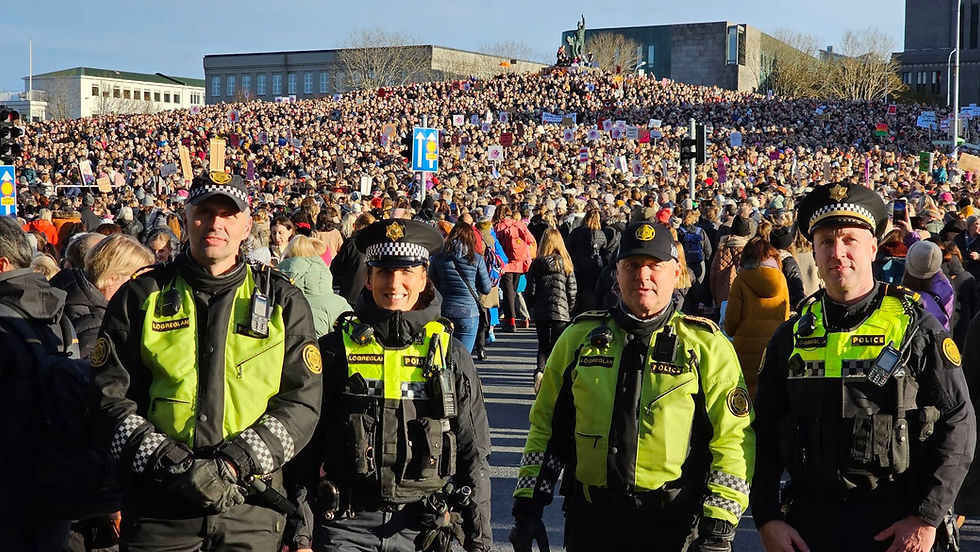

A Police Force That Doesn't Want to Look Like an Army
The Icelandic police—Lögreglan—are one of the clearest symbols of the country's unique approach to public safety.
Unlike in many countries, ordinary police officers do not routinely carry handguns on their belts. Firearms are stored in police vehicles and are only used in exceptional circumstances.
Standard equipment includes items such as batons and pepper spray.
The introduction of Tasers in recent years sparked considerable public debate, with many Icelanders concerned that their police force might drift away from its traditional role as a service for the community rather than a show of force.
The exception is Víkingasveitin, Iceland's special response unit, which deals with the most serious incidents, including armed threats and counter-terrorism operations.
A Warning Before a Fine
I have one personal experience with the Icelandic police that I've never forgotten.
While driving east from Reykjavík along the Ring Road, I was travelling faster than I should have been. A police patrol with a speed radar was parked beside the road.
Instead of immediately pulling me over and issuing a ticket, the officers simply flashed their lights, giving me a clear warning to slow down.

They gave me the opportunity to correct my mistake.
That experience perfectly reflected the attitude I encountered at the time. The goal wasn't to punish drivers as quickly as possible—it was to make sure they drove safely.
Today, memories like this almost sound unbelievable.
That's exactly why they're worth preserving.
They remind us what Iceland was truly like: a country built on extraordinary trust, one that has gradually changed but still remains among the safest places on Earth.
Police as Part of the Community

One of the defining characteristics of Icelandic policing is its close relationship with the public. The Reykjavík Metropolitan Police have even gained international attention for their social media presence, where they share not only official announcements but also light-hearted moments from everyday police work.
The philosophy is simple: people should see the police not as a distant authority, but as part of the community they serve.
Prevention also plays a central role. When dealing with young offenders, the primary objective is not punishment but preventing them from returning to crime in the future.
Iceland's Justice System: Less Revenge, More Rehabilitation
Iceland's criminal justice system follows the Scandinavian model, where the emphasis is placed on rehabilitation rather than retribution.
The main goal is not to isolate offenders from society forever, but to prepare them for a successful return to everyday life.
Unlike many countries, Iceland does not have a standard sentence of life imprisonment.
The maximum ordinary prison sentence is 16 years, although longer forms of preventive detention are possible in exceptional cases involving the most serious offences.
For less serious crimes, courts frequently use alternative sentences, including:
community service,
electronic home detention,
suspended sentences.
The prison system also focuses heavily on gradual reintegration. Inmates are encouraged to work, study, and prepare for life after their release, making rehabilitation a central part of the system rather than an afterthought.
Is Iceland Safe in a Changing World?
Iceland remains one of the few places where people can still walk through the streets late at night with a sense of security that has become increasingly rare elsewhere.
The days when people routinely left their homes unlocked and their car keys in the ignition are slowly disappearing.
Not because Iceland has become an unsafe country.
Rather, because even a small island in the middle of the North Atlantic is no longer isolated from the rest of the world.
Globalization, tourism, and a more diverse society have brought new challenges.
Yet Iceland continues to respond in a way that remains remarkably unique—placing trust, prevention, and the relationship between citizens and the state at the heart of its approach to public safety.

About the Author
Iceland has fascinated me for many years. Over the course of numerous journeys across the island, I have driven tens of thousands of kilometers, experienced storms that changed travel plans within minutes, and witnessed days when choosing the right route meant discovering places that most visitors never see. I documented many of these experiences in my documentary film Island in the North.
Through this website, I share practical travel advice, up-to-date information, and firsthand experiences from the field to help others explore Iceland more safely and gain a deeper understanding of its unique landscapes and ever-changing nature.


Komentáře