
EUROPE CLEANS UP LITTER. ICELAND MOSTLY DOESN’T LEAVE IT THERE. WHAT’S THE DIFFERENCE?

When I first arrived in Iceland, I noticed something I couldn’t quite put into words at first. I’m not talking about volcanoes, waterfalls or lava fields. It was something much more ordinary. There was hardly any litter in the landscape. No PET bottles in the ditches, no cans, scraps of paper, napkins or snack wrappers scattered along the roads. Even at places visited by thousands of tourists, there was surprisingly little rubbish. And it was the same in towns. Even in Reykjavík.

For someone from Central Europe, this is a striking detail. The more often I returned to Iceland, the more I wondered why this was the case. Is it a stronger connection between local people and their own landscape? Education? Social norms? Or simply a different system?
Perhaps it is a little of everything. But maybe there is something even more interesting behind it: some things in Iceland are simply regarded as things you don’t do.
Imagine Two Countries
Imagine the same person.
He is thirty years old, driving a car. He buys a can of beer or a PET bottle, drinks it, and is left holding an empty container.
In both countries, he has exactly the same opportunity to roll down the window and throw it into a ditch.
Nothing physically prevents him from doing it.
The difference, then, may not be in what he can do, but in what he can imagine himself doing.
And this is where the Icelandic story becomes particularly interesting.
Maybe it is not so much about ecology as it is about social norms.
If you grow up in an environment where it is taken for granted that rubbish belongs in a bin, or that you take it home with you, throwing a bottle out of a car window is not simply a minor offence.
It is something you just don’t do.
Of course, there is no study proving that Icelanders never throw rubbish from cars or that they never accidentally drop something outdoors. Such a conclusion would be absurd. Iceland is not a litter-free country either.
But a number of studies point to something important: a connection with nature, environmental education and pro-environmental behaviour are genuinely related in Iceland.
Nature Is Not Just a Backdrop
Nature is everywhere in Iceland.
It is not simply somewhere you visit once a year on holiday. It surrounds people on their way to work, while driving, hiking, fishing, staying at a summer house or simply going for a walk.
And a relationship with nature can begin developing at a very early age.
A study published in 2025 followed 123 children from six Icelandic preschools.
The researchers examined their relationship with nature, including whether they enjoyed spending time outdoors, how much empathy they felt towards nature and how they behaved in environmentally responsible ways.
The result is interesting: enjoyment of nature was significantly associated with pro-environmental behaviour. The correlation between the two factors was 0.51.
In other words, children who had a more positive relationship with nature were also more likely to behave in environmentally friendly ways.
Protecting nature, then, does not necessarily have to begin with a prohibition.
It can begin with a child learning to love nature, and beginning to care about it.
And once that happens, leaving a meadow clean may feel just as natural as cleaning your own room.
They Learn It at School
Iceland also has a long tradition of environmental education.
The Grænfáninn – Eco-Schools programme has been operating in Iceland since 2001. According to the environmental organisation Landvernd, around 200 schools at all educational levels are involved, from preschools to universities.
It is not simply about having one lesson on ecology.
Schools participating in the programme are encouraged, among other things, to reduce waste and the consumption of water and energy, increase environmental awareness and involve students in decision-making and practical projects.
The child is not merely a listener.
They are supposed to be part of the change.
Environmental behaviour therefore does not remain just a piece of knowledge, such as “plastic goes in the yellow recycling bin”. It becomes a practical part of everyday school life.
An analysis of the Icelandic school curriculum examined education for sustainable development in preschools, primary schools and secondary education. The authors identified, among other things, work with values, attitudes and emotions towards nature, responsible use of natural resources, democracy, participation and the ability to take action.
That is an important distinction.
It is not enough to know what is environmentally friendly. You also need to develop a relationship with nature and the ability to act accordingly.

And Then the Tourist Arrives
Interestingly, the same principle does not end at school.
In Iceland, visitors encounter it in tourism as well.
Hostels, hotels, guesthouses and other accommodation providers can obtain environmental certifications and must meet specific criteria.
The Icelandic Vakinn system, operated under the Icelandic Tourist Board, includes environmental requirements for different types of tourism businesses. It covers areas such as water, energy and waste management, with separate environmental certifications also available.
It is therefore not simply a “we are green” label, but a set of criteria against which businesses are assessed.
Environmental behaviour is thus brought directly to the tourist.
Save water. Sort your waste. Use resources responsibly. Respect nature.
Hostels Teach Their Guests About Sustainability Too
For example, HI Iceland has its own sustainability policy. The organisation says it aims to educate guests about sustainability and encourage responsible travel.
According to its policy, its hostels seek to reduce unnecessary single-use products, choose environmentally labelled products, avoid polluting chemicals, recycle waste and reduce food waste.

The approach also includes more responsible use of water and energy.
Two HI hostels in Reykjavík have also received the Nordic Swan Ecolabel, the official Nordic environmental label. HI Iceland says the certification assesses a wide range of factors, from detergents and lighting to furniture and equipment.
And suddenly, an interesting chain emerges:
A child learns to connect with nature at school.An adult encounters environmental rules in everyday life.And a tourist encounters them in a hostel, hotel or guesthouse.
Environmental behaviour therefore does not have to be purely a personal decision.
The environment around us keeps reminding us of it.
When Littering Is More Embarrassing Than Throwing Something Away
This is where we reach the most interesting part.
The law can tell you:
Don’t throw rubbish on the ground.
But society can send a much stronger message:
Normal people don’t do that.
There does not have to be a police officer standing beside every ditch. There does not have to be a camera on every hiking trail. Nobody has to monitor every driver.
If certain behaviour is regarded as obviously unacceptable, people begin to police themselves.
That is why perhaps a more interesting question than “Why do Icelanders protect nature?” is this:
Why does it feel normal to them not to pollute it?
Research among young people in Iceland shows that environmental engagement is associated with pro-environmental behaviour and sustainable lifestyles.
The study used questionnaires from 784 students aged 14 and 18, interviews with 29 young people and data from 177 school principals.
So this is not merely a theory.
The researchers were actually looking for factors associated with how young people behave.

A Dumping Ground Starts with a Single Bag
An illegal dumping site does not appear overnight.
It starts with one rubbish bag.
One tyre.
One refrigerator.
One bottle thrown from a car.
When someone arrives at a place where rubbish is already lying around, the psychological boundary can shift.
“It’s already dirty anyway.”
And they add another bag.
A small violation of a norm can gradually become a new norm. But the opposite can happen too. When you arrive somewhere that is clean, it may be much harder to be the first person to make it dirty.
Cleanliness does not necessarily have to be the result of constant cleaning. It can be the result of an expectation that everyone who comes after you will behave in the same way as those who came before.
Litter in Iceland’s Nature: Iceland Is Not a Country Without Waste
This is where we need to put the brakes on the romantic image.
Iceland obviously produces waste and has its own environmental problems. As tourism has grown, so have problems including littering, vandalism and damage to nature.
A study of nature-based tourism in Iceland pointed out that the rapid growth in visitor numbers has brought, among other things, littering and other forms of environmental pressure.
That is important.
Because the point is not to claim that Iceland is some kind of ecological utopia.
It isn’t.
The difference is something much more specific.
It is about how often you see rubbish where it simply should not be.
Clean Spaces Are Not Just a Matter of Character
The system obviously plays a role as well.
The availability of collection points. Waste collection. Recycling. Deposit schemes. Municipal services. Enforcement against illegal dumping.
All of these things matter.
But the system alone does not explain an empty roadside ditch.
A bin can be in the right place.
Waste collection can work.
Recycling can be readily available.
In the end, however, someone still has to decide not to throw that bottle out of the car.
And that is where personal responsibility begins.
So Why Doesn’t an Icelander Throw a Can Out of the Window?
Perhaps because, over the course of their life, they have learned a few very simple rules.
Nature is not a rubbish bin.
If you bring something into nature, you take it away again.
Public space belongs to everyone.
Water, energy and other resources cannot simply be taken for granted.
And perhaps most importantly, nobody wants to be the person who does something that simply isn’t done.
Not because the law is standing over them.
Not because they are afraid of a fine.
But because it would feel wrong.
Of course, this is an interpretation, not something research has established as the single cause. The cleanliness of public spaces is the result of multiple factors – from infrastructure and regulations to education and individual behaviour.
But social norms may help explain one seemingly trivial thing:
why a person who has the opportunity to do something may never even consider doing it.
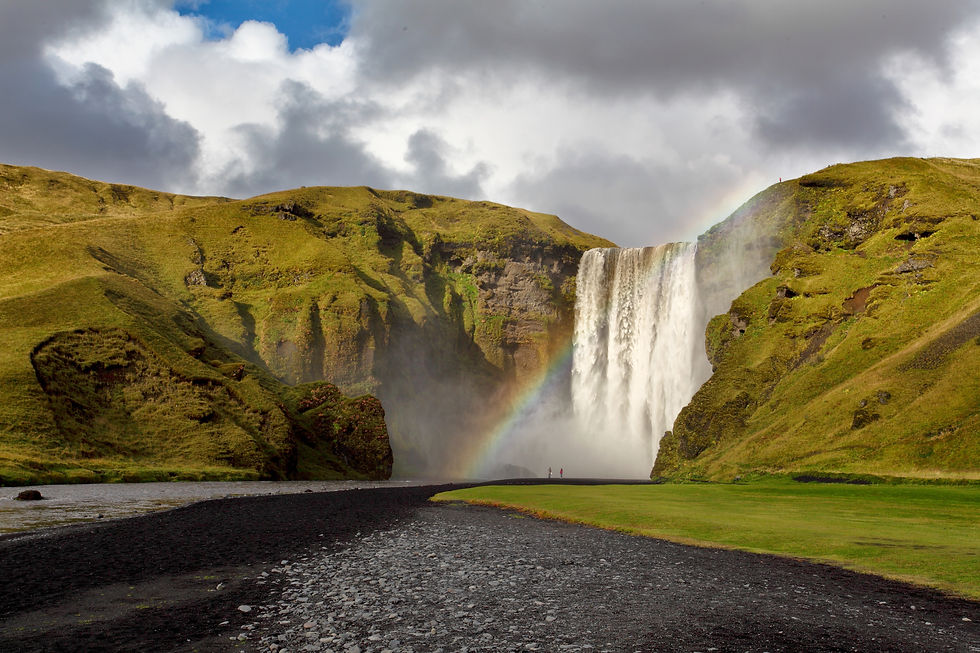
Perhaps This Is Iceland’s Greatest Environmental Lesson
Iceland is certainly not an ecological paradise.
It has cars. It has planes. It has industry. It produces waste. Its nature is under pressure from mass tourism.
And yet, when travelling through the Icelandic landscape, you often experience a strange feeling.
That the country still somehow belongs to itself.
That when you are standing in the middle of a lava field, beside a river or on the coast, you do not also have to watch your step to avoid someone else’s rubbish.
And perhaps that is where there is something that cannot be solved with another bin, another fine or another law.
Because the cleanest landscape is not the one that someone constantly cleans.
It is the one people do not want to throw rubbish into.
And perhaps, then, the question is not why Icelanders are “more environmentally friendly”.
Perhaps the more interesting question is:
When does protecting nature become so natural that it does not even occur to someone to do the opposite?
Sources and studies
Norðdahl, K., Orman, M., Wanless, S. & Birgisdóttir, F. (2025): Enjoyment, Empathy, and Environmental Behavior: A Study of Young Children’s Nature Connection in Iceland – a study of 123 children from six Icelandic preschools. University of Iceland – study
Jóhannesson, I. Á., Norddahl, K., Óskarsdóttir, G., Pálsdóttir, A. & Pétursdóttir, B. (2011): Curriculum Analysis and Education for Sustainable Development in Iceland – an analysis of environmental and sustainability education in Icelandic school curricula. University of Iceland – study
Guðjohnsen, R. Þ., Jordan, K. E., Jónsson, Ó. P., Aðalbjarnardóttir, S. & Garðarsdóttir, U. E. (2024): Good Citizenship and Sustainable Living: Views, Experiences, and Opportunities Among Young People in Iceland – research involving 784 students, 177 school principals and 29 interviews with young people. University of Iceland – study
Sorrell, E. & Plante, A. F. (2021): Dilemmas of Nature-Based Tourism in Iceland – a study of the impacts of growing tourism on Icelandic nature, including littering and vandalism. University of California Press – study
Landvernd – Grænfáninn / Eco-Schools – information about Iceland’s environmental education programme, operating since 2001. Landvernd – Grænfáninn
HI Iceland – Sustainability Policy – the official sustainability policy of Iceland’s hostel network, covering waste, water, energy and environmentally responsible behaviour among guests. HI Iceland – Sustainability Policy
HI Iceland – Sustainability Certification – information about HI hostels’ environmental certification and the Nordic Swan Ecolabel. HI Iceland – Sustainability Certification
Vakinn – Environmental Criteria – the official environmental criteria of Iceland’s tourism quality and environmental certification system. Vakinn – Environmental Criteria

About the Author
Iceland has fascinated me for many years. Over the course of numerous journeys across the island, I have driven tens of thousands of kilometers, experienced storms that changed travel plans within minutes, and witnessed days when choosing the right route meant discovering places that most visitors never see. I documented many of these experiences in my documentary film Island in the North.
Through this website, I share practical travel advice, up-to-date information, and firsthand experiences from the field to help others explore Iceland more safely and gain a deeper understanding of its unique landscapes and ever-changing nature.


Komentáře