
10 THINGS THAT MAKE ICELANDIC ONE OF THE WORLD'S MOST FASCINATING LANGUAGES
- Roman Pech
- 7. 7.
- Minut čtení: 4

The first time you open a map of Iceland, it may seem as if someone randomly strung together a collection of impossible-looking letters. Yet Icelandic is one of Europe's best-preserved languages, and modern Icelanders can still read texts written nearly a thousand years ago with surprisingly little difficulty.
So what makes their language so unique?

The Icelandic Language of the Vikings Lives On
Icelandic has changed remarkably little since the first Norse settlers arrived in the 9th century. As a result, modern Icelanders can read the medieval Icelandic sagas with little or no translation.
For most Europeans, this is almost unimaginable—just try reading English or Czech as it was written around the 11th century.
Instead of Borrowing Words, They Create New Ones
While many languages readily adopt English vocabulary, Icelandic often replaces foreign words with new terms built from native roots.
For example:
tölva = computer
sími = telephone
veðurfræði = meteorology
Rather than borrowing English expressions, Icelanders continue to expand their language using traditional Icelandic vocabulary.

Two Letters That Almost Disappeared from Europe
Icelandic still uses two ancient letters:
Þ (thorn) – pronounced like the th in thing.
Ð (eth) – pronounced like the th in this.
These two letters are among the biggest challenges for foreign visitors learning Icelandic.
They Don't Have Surnames as We Know Them
Most Icelanders do not use family surnames. Instead, they use patronymics or, less commonly, matronymics.
For example:
Jónsson = Jón's son
Jónsdóttir = Jón's daughter
Because of this, Icelanders normally address each other by their first names—even presidents, ministers and university professors.
The Phone Directory Is Sorted by First Name

Since most Icelanders do not have inherited surnames, telephone directories are arranged alphabetically by first name rather than by family name. While this may seem unusual to visitors, it is perfectly natural in Iceland.
Every Place Name Tells a Story
Many Icelandic place names are descriptive compounds that literally explain the surrounding landscape.
For example:
Reykjavík = Smoky Bay
Eyjafjallajökull = Glacier of the Island Mountains
Jökulsárlón = Glacial River Lagoon
Once you understand the meaning of the individual words, Iceland's map suddenly begins to make perfect sense.
Pronunciation Can Be Tricky
At first glance Icelandic words look intimidating, but their pronunciation follows fairly consistent rules.
For example:
ll is often not pronounced like the English "l", but as a distinctive voiceless sound somewhat similar to tl.
j is pronounced like the English y in yes.
þ sounds like the th in thing.
For instance, Keflavík is pronounced approximately Kep-la-veek, because the letter f between vowels often sounds closer to a soft, unvoiced p. This is a simplified explanation for visitors—the authentic pronunciation is slightly subtler.

Some Words Are Real Tongue Twisters
Try reading these aloud:
Eyjafjallajökull – approximately AY-ya-fyatla-YOE-kuhtl
Fjaðrárgljúfur – approximately FYA-thraur-GLEW-vur
Kirkjubæjarklaustur – approximately KIRK-yu-BYE-yar-KLOY-stur
Þingvellir – approximately THING-vet-lir
Snæfellsjökull – approximately SNYE-fetls-YOE-kuhtl
Even experienced travellers often struggle with their pronunciation.
Learn Some Icelandic:
When you click on the name, you will hear the pronunciation
A Small Language with a Great Literary Tradition
Although Iceland has a population of only about 400,000 people, it publishes an impressive number of books every year. Reading and writing are deeply rooted in Icelandic culture. Even the famous Czech novel The Good Soldier Švejk has been translated into Icelandic.
Language as a National Identity
For Icelanders, language is far more than a means of communication. It is a symbol of their history, independence and cultural identity. That is why they continue to protect its uniqueness even in an increasingly globalised world.

How Do You Say "Solar Eclipse" in Icelandic?
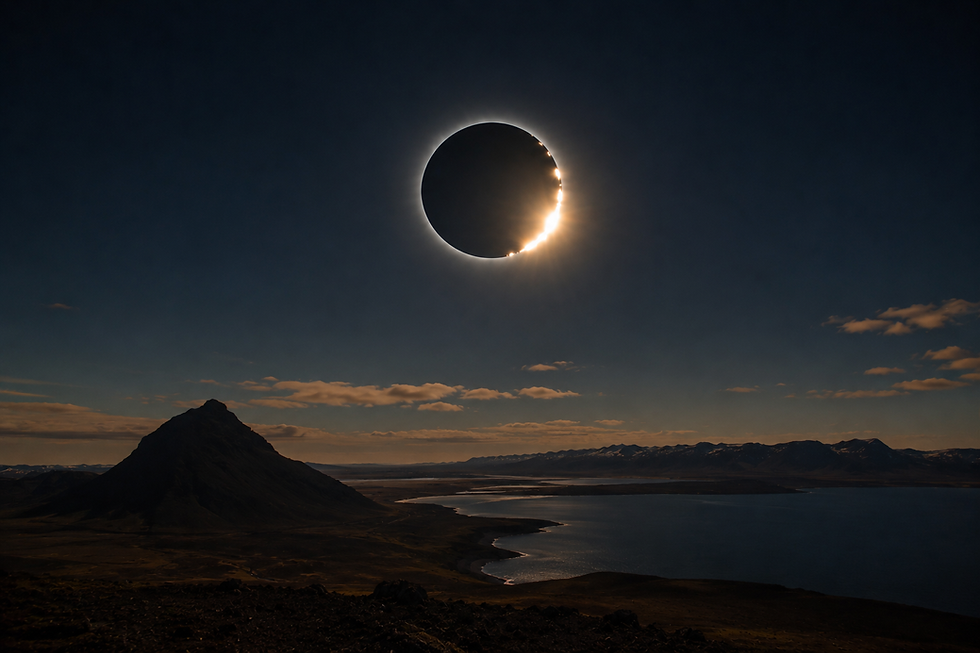
If you are travelling to Iceland for the total solar eclipse on 12 August 2026, it may be useful to learn its Icelandic name.
A solar eclipse is called sólmyrkvi.
The word combines two elements:
sól = sun
myrkvi = darkness or eclipse
Literally, it means "sun darkness" or "darkening of the Sun."
A total solar eclipse is called almyrkvi á sólu.
This is the expression you will encounter frequently in Icelandic news, weather forecasts and public information during the months leading up to the eclipse. On 12 August 2026, the path of totality will cross western Iceland, making the country one of the world's best places to witness this extraordinary astronomical event.
One Last Interesting Fact
You may be surprised to learn that most Icelandic place names are not random at all. Once you know just a few basic words, you will begin recognising glaciers (jökull), waterfalls (foss), mountains (fjall) and bays (vík) all across the map.
In Iceland, the landscape quite literally tells its own story through its language.

About the Author
Iceland has fascinated me for many years. Over the course of numerous journeys across the island, I have driven tens of thousands of kilometers, experienced storms that changed travel plans within minutes, and witnessed days when choosing the right route meant discovering places that most visitors never see. I documented many of these experiences in my documentary film Island in the North.
Through this website, I share practical travel advice, up-to-date information, and firsthand experiences from the field to help others explore Iceland more safely and gain a deeper understanding of its unique landscapes and ever-changing nature.


Komentáře