
2026 SOLAR ECLIPSE IN ICELAND: CLOUDS ARE EXPECTED TO COVER ALMOST THE ENTIRE ISLAND. WHERE IS THERE STILL HOPE?

Only yesterday, eclipse chasers could still hope that the weather forecast would improve significantly at the last minute. But one day before the total solar eclipse on August 12, 2026, Iceland is facing a far less optimistic outlook according to the latest forecast from the Icelandic Meteorological Office, Veðurstofa Íslands.
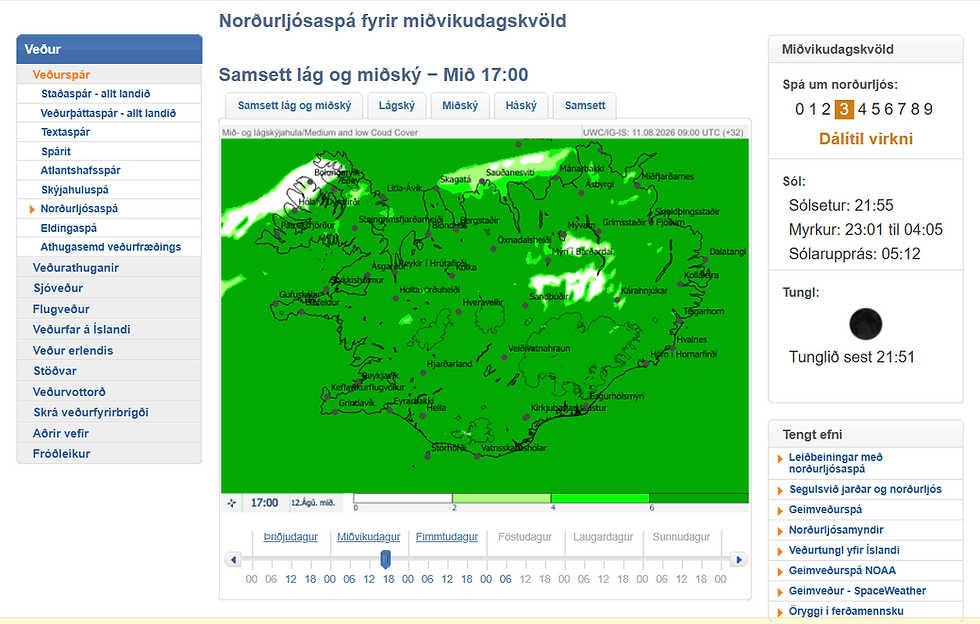
According to the latest cloud cover map on [vedur.is], low or medium-level clouds are expected to cover almost the entire island from around 5 p.m. Meteorologists are also forecasting showers in many areas. This is a major problem for eclipse watchers – totality will last only around one to two minutes in western Iceland, meaning that even a brief break in the clouds may not occur at exactly the right moment.
A few gaps are still visible
But all is not lost. The forecast map still shows several areas with less cloud cover, particularly at the western tip of the Westfjords. This is where those willing to travel in search of clear skies may look for their best chance in the coming hours.
The problem is that even these gaps are expected to be quickly covered by clouds according to the current forecast. The situation could therefore change literally from hour to hour. And because the total eclipse will only cross a relatively narrow path in western Iceland, it is not simply a matter of driving anywhere with clearer skies. The location must also be within the path of totality.
2026 Solar Eclipse in Iceland: The final hours will decide
For thousands of visitors, the real race against the weather is now beginning. A forecast made one day in advance may still not accurately show where the clouds will actually break on Wednesday afternoon. Icelandic weather is also known for changing rapidly.
The total solar eclipse will be visible from Iceland on Wednesday afternoon and, depending on the location, totality will last from around one minute to more than two minutes. In Hellissandur, for example, totality is expected to begin at approximately 5:46 p.m. local time and last for more than two minutes.
This means that what matters will not simply be where there will be less cloud tomorrow, but above all where the sky will actually open at the exact moment of totality.
For now, one major question hangs over Iceland: will a window in the clouds open tomorrow, for a few dozen seconds or perhaps several minutes, exactly where it is needed?
Eclipse chasers will have to wait until the final hours before one of the year's most significant astronomical events to find out.


Komentáře