
ECLIPSE IN ICELAND: IT RAINED IN SOME PLACES, WHILE THE CLOUDS CLEARED AT THE LAST MINUTE

The total solar eclipse on August 12, 2026, brought as many as 80,000 visitors to Iceland. But instead of clear skies, many of them were met with clouds and rain. Some observers nevertheless managed to see totality – in some cases, the sky cleared just five minutes before totality began. Experiences from different parts of Iceland showed that on the day of the eclipse, literally a few kilometres and a few minutes could make all the difference.

Tens of thousands of people waited for two minutes of darkness
Iceland had been preparing for the eclipse for months. According to estimates, as many as 80,000 visitors were expected to arrive in the country – roughly one fifth of Iceland's population.
The longest totality on Iceland's mainland occurred at Látrabjarg, where it lasted approximately 2 minutes and 14 seconds. In Reykjavík, totality lasted less than a minute.
Thousands of people headed for Snæfellsnes. Icelandia, for example, transported 1,200 foreign tourists in 24 buses. Hellissandur also hosted a multi-day Eclipse Festival, which, according to Icelandic news outlet Vísir, sold around 3,000 tickets to visitors from 75 countries.
But all these people were facing the same question:
Would the sky open at the crucial moment?
The forecast did not look good
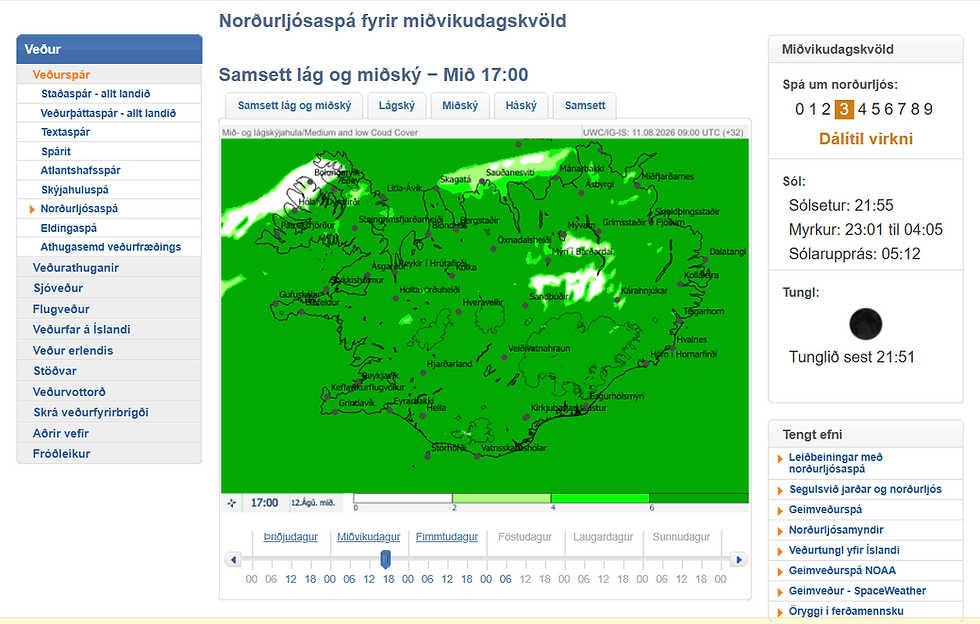
Shortly before the eclipse, the Icelandic Meteorological Office was forecasting cloud cover across most of the country. The best chances of breaks in the clouds were expected around Breiðafjörður and in the Westfjords.
And that was exactly where the dramatic differences between locations just a few dozen kilometres apart became apparent.
Hellissandur: a miracle five minutes before totality

One of the most striking accounts came from a visitor on Reddit. According to the observer, the area within the path of totality had experienced 100% cloud cover and rain throughout the day. He therefore decided not to worry too much about the eclipse and went on a drive around Snæfellsjökull.
He arrived in Hellissandur about ten minutes before totality began.
The Sun was still completely hidden.
Then something happened that, by that point, seemed almost impossible:
“Then, 5 minutes before totality, we could suddenly see the crescent sun through the clouds!”
The gap in the clouds, he said, lasted not only until the beginning of totality, but for several minutes afterwards as well.
“We perfectly witnessed totality despite the worst possible conditions.”
The visitor described it as incredible luck. It had been raining throughout the day and the sky had remained overcast, but at the crucial moment a window opened in the clouds and remained open throughout totality.
Just a few kilometres away, things were very different
The experience of another visitor to Snæfellsnes makes the contrast even more striking.
For most of the partial phase, he said, he could not see the Sun at all. The sky was overcast and it was raining. Shortly before totality, however, the cloud layer thinned and the Sun appeared.
This time, he even managed to see one of the most beautiful moments of a solar eclipse – the diamond ring.
“I watched it shrink and actually saw the diamond ring immediately before second contact.”
But just as totality began, the sky clouded over again.
“The Sun disappeared behind the clouds again right as totality began, so I never saw the corona.”
Even so, he described the experience as fascinating. Although he could no longer see the Sun itself, he watched the light change dramatically within seconds and saw twilight appear on the horizon.
Most interestingly, according to his account, people just a short distance away in the Snæfellsnes area had a gap in the clouds during totality and were able to see the eclipse.

Westfjords: being farther west did not necessarily mean better weather
Another account came from Selárdalur in the Westfjords.
According to the observer, there was light cloud cover and the Sun occasionally broke through. But around totality, the sky closed in.
“Got light clouds, sun sometimes got through, but not around totality.”
He was nevertheless able to use his eclipse glasses at the beginning of the partial phase because there were several gaps in the clouds.
“Got to use the glasses at the very start because there were a few gaps in the clouds, but those disappeared.”
And despite missing the Sun during totality, his overall verdict was positive:
“That aside, I witnessed it and I found it to be a really cool experience!”
Látrabjarg got lucky
Látrabjarg offered one of the best locations on the whole of Iceland in terms of the duration of totality. And some of the positive reports came from there.
During the eclipse, people in a live Reddit discussion reported that while the sky was completely overcast in other locations, Látrabjarg had better visibility at the crucial moments.
One comment summed it up briefly:
“Good visibility in Látrabjarg. I think I caught a solar protuberance?”
Another observer, however, said that visibility was still good shortly before totality, but that clouds moved in during the total phase itself.
Once again, it showed just how localized the weather conditions were.
Reykjavík: clouds hid totality

The situation in the capital was considerably worse.
In a Reddit discussion titled We had the solar eclipse glasses ready and the weather said absolutely not!, one visitor wrote:
“Westfjords people, please tell me you actually got some use out of these glasses because Reykjavík absolutely did not.”
The Guardian's live coverage likewise reported that clouds affected viewing conditions in parts of Iceland, while some locations managed to see totality.
Reuters also quoted 33-year-old lawyer Eduarda Ortiz in Reykjavík:
“It was like a whole day just came at once and I felt goosebumps...”
Even though she could not see the Sun itself, the sudden transition into darkness was a powerful experience.
Ólafsvík: “That's Iceland for you”
Visitors in Ólafsvík were also mostly watching the clouds during the eclipse.
In a live Reddit discussion, one visitor asked what to do if the sky remained completely overcast an hour before totality. The response was succinct:
“That’s Iceland for you, the cloud cover is all over the country.”
Another visitor added that the previous day had been completely clear, while on eclipse day the sky clouded over.
“It was sunny without a single cloud yesterday... How ironic!”
So, was the eclipse in Iceland a failure?
No. But it was far from successful for everyone.
The available eyewitness reports paint a remarkably varied picture:
Reykjavík: clouds blocked totality, but the sudden darkness was clearly noticeable.
Snæfellsnes: some locations had rain and saw almost nothing of the Sun throughout the day, while elsewhere the sky opened just before totality.
Hellissandur: one visitor described extraordinary luck – a gap in the clouds appeared five minutes before totality and remained open throughout the entire event.
Westfjords: conditions varied dramatically from one location to another. Some people saw only the partial phase, while others had much better conditions during totality.
Látrabjarg: some reports described good visibility, while others reported clouds moving in shortly before or during totality.
And that was broadly consistent with the final forecast from the Icelandic Meteorological Office, which shortly before the eclipse identified Breiðafjörður and the Westfjords as areas with the best chances of breaks in the cloud cover.
80,000 people, but everyone saw a different Iceland
The figure of up to 80,000 visitors remains an estimate, rather than an exact count of people who travelled to Iceland specifically for the eclipse.
The number of people in the Westfjords increased several times over compared with a normal August day, and authorities introduced traffic restrictions. Vehicle access to Látrabjarg was restricted, for example, while special traffic arrangements were put in place around Snæfellsnes.
Yet the biggest lottery was not traffic.
It was the weather.
On August 12, 2026, you could stand directly in the path of totality, wait for this moment for an entire year, and still see nothing but dark clouds.
And someone just a few kilometres away could have the exact opposite experience.
The clouds parted.
The Sun disappeared behind the Moon. For a few minutes, day turned into night.
And then it was over.
Iceland did not disappoint. It simply showed its true nature.
In Iceland, the weather does not care how important your day is.
And that is why August 12, 2026, will live on in visitors' memories in two completely different ways.
For some, it will be the day when the sky opened five minutes before totality and they witnessed a total solar eclipse despite rain and all-day cloud cover.
For others, it will be the day when they stood directly in the path of totality, darkness suddenly descended around them, but the Sun remained hidden behind the clouds.
Both experiences are a true picture of Iceland's eclipse.
Sometimes, a few kilometres made all the difference. And sometimes, just a few minutes.

About the Author
Iceland has fascinated me for many years. Over the course of numerous journeys across the island, I have driven tens of thousands of kilometers, experienced storms that changed travel plans within minutes, and witnessed days when choosing the right route meant discovering places that most visitors never see. I documented many of these experiences in my documentary film Island in the North.
Through this website, I share practical travel advice, up-to-date information, and firsthand experiences from the field to help others explore Iceland more safely and gain a deeper understanding of its unique landscapes and ever-changing nature.


Komentáře