
WHAT WILL YOU SEE DURING THE TOTAL SOLAR ECLIPSE IN ICELAND 2026? SECOND BY SECOND

On August 12, 2026, one of the rarest natural spectacles on Earth will unfold above Iceland. Many people imagine a solar eclipse as nothing more than the Moon covering the Sun. In reality, a total solar eclipse is far more dramatic.
In just a few minutes, the landscape transforms in ways that cannot be compared to an ordinary sunset or a cloudy day. Temperatures drop, daylight takes on an eerie appearance, planets become visible, and the Sun’s magnificent corona shines around the black silhouette of the Moon. So what exactly will you experience during the total solar eclipse in Iceland?

Several Minutes Before Totality
About ten to fifteen minutes before totality, most people begin to notice that something unusual is happening.
This is not normal darkness. Sunlight gradually loses its familiar intensity, and the landscape takes on an almost surreal appearance. Shadows become unusually sharp, colors seem muted, and the light resembles a strange mix of sunshine and an approaching storm.
In Iceland, this effect may be even more striking thanks to the island’s vast open landscapes, dramatic coastlines, and unobstructed horizons.
The Final 60 Seconds
Only a thin crescent of the Sun remains visible.
The world around you begins to change rapidly. Many observers notice a sudden drop in temperature. Birds may fall silent, and animals often behave as if evening has arrived.
On bright surfaces, delicate rippling patterns known as shadow bands may appear. These shimmering waves of light are caused by atmospheric turbulence and are among the rarest eclipse phenomena.
The anticipation becomes almost tangible. Everyone is watching the Sun.
Read More About the Total Solar Eclipse in Iceland on August 12, 2026 HERE
In these articles, you will learn:
Where the longest total eclipse will occur
Which areas have the best chances of clear skies
Where traffic congestion and gridlock are most likely
Whether it is still possible to find accommodation
What prices to expect during the eclipse period
The historical connections between the 1954 and 2026 eclipses
The Final 10 Seconds
Now comes the most dramatic phase of the entire eclipse:
Baily’s Beads
The last rays of sunlight shine through valleys and depressions along the rugged edge of the Moon.
Instead of a smooth solar crescent, a string of brilliant points of light appears, resembling glowing pearls.
These are known as Baily’s Beads, and they last only a few seconds.
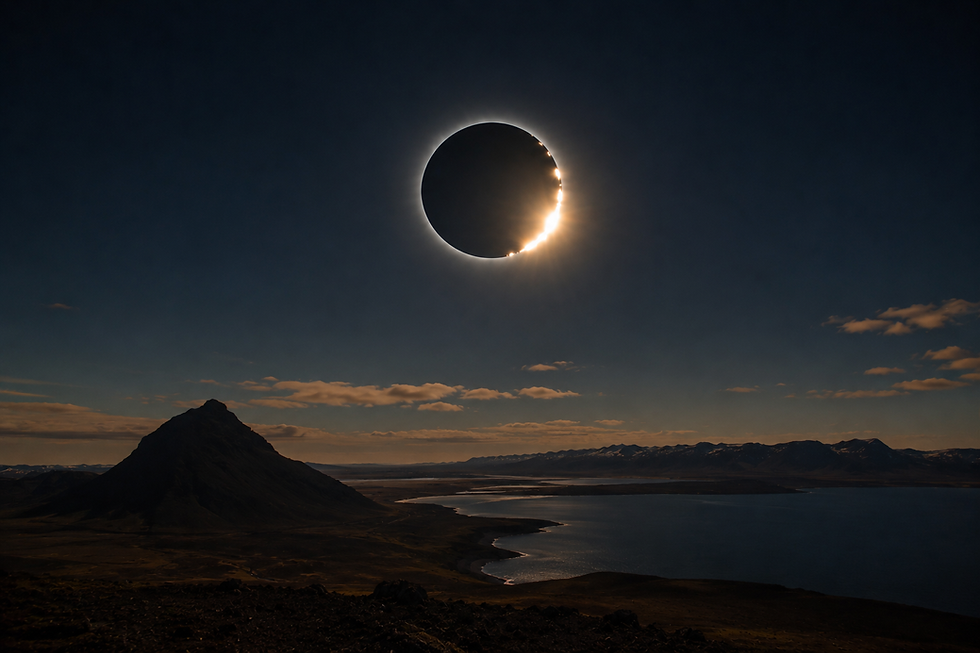
The Diamond Ring
Then only a single brilliant point of sunlight remains.
The black disk of the Moon and this final dazzling flash create the famous Diamond Ring Effect — one of the most photographed moments of any eclipse.
And then...
The light goes out.
Totality Begins
For the first time, it is safe to remove your eclipse glasses.
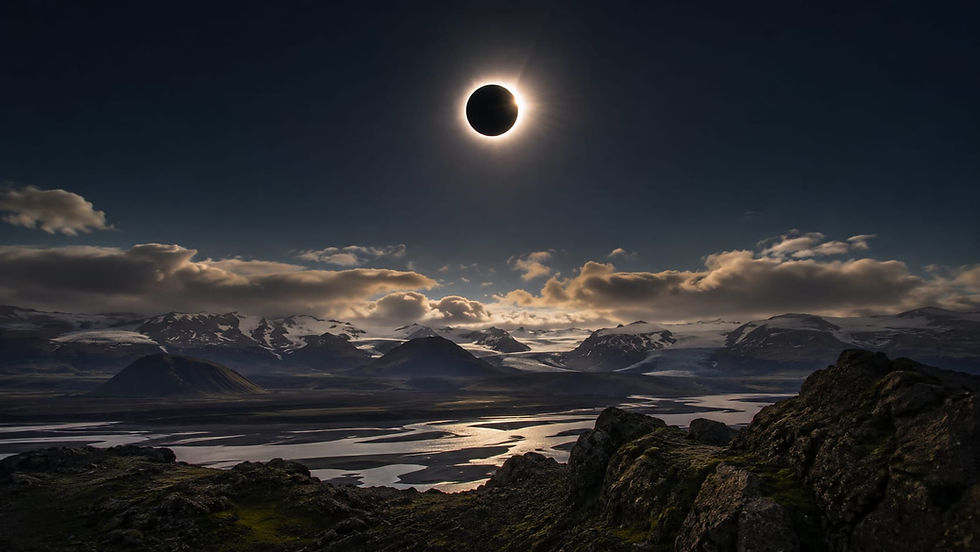
Suspended in the sky is a perfectly black lunar disk surrounded by something most people have never seen with their own eyes.
The Solar Corona
A delicate silver-white glow suddenly appears around the Moon.
This is the solar corona, the Sun’s outer atmosphere, normally hidden by the overwhelming brightness of the solar surface.
The corona forms intricate streamers and filaments stretching far into space. Its appearance is different during every eclipse and depends on the Sun’s current activity cycle.
For many eclipse chasers, this is the moment they have traveled across the world to witness.
Many later say that no photograph can truly capture the beauty of the corona seen with the naked eye.
Day Turns Into Night
The landscape darkens dramatically.
Not completely, however.
Along the entire horizon, a strange 360-degree twilight appears. In every direction, the distant landscape remains illuminated by sunlight outside the path of totality.
You are standing inside the Moon’s shadow while the world beyond it remains in daylight.
For many observers, this surreal horizon glow is almost as unforgettable as the corona itself.
Planets and Stars Appear
During totality, the brightest planets and stars may become visible.
If conditions are favorable in August 2026, observers may be able to spot Venus and several bright stars shining in the daytime sky.
Interestingly, Icelandic newspapers described exactly this phenomenon before the total solar eclipse of 1954:
“During the total eclipse, stars and planets will be visible.”
They were absolutely right.

The Moon’s Shadow Racing Across the Landscape
If you are standing on an elevated viewpoint — perhaps on the Snæfellsnes Peninsula or in the Westfjords — you may witness another extraordinary sight.
The Moon’s shadow itself.
A vast wall of darkness races across the landscape at tremendous speed, moving thousands of kilometers per hour.
Few natural phenomena are as awe-inspiring.
The Return of Light
And just as suddenly as totality began, it comes to an end.
A brilliant point of sunlight appears on the opposite side of the Moon.
The Diamond Ring returns.
Baily’s Beads appear once more.
Within seconds, daylight floods back across the landscape.
Birds begin to sing again. Colors return. The world resumes its normal appearance.
Only then do many people fully realize what they have just experienced.

An Experience Beyond Photography
Before witnessing their first total solar eclipse, many people struggle to understand why others travel thousands of kilometers for just a few minutes of darkness.
Afterward, they usually understand.
A total solar eclipse is not simply an astronomical event. It is one of the most profound natural experiences available anywhere on Earth.
And on August 12, 2026, Iceland will provide one of the most spectacular settings imaginable for witnessing it.

About the Author
Iceland has fascinated me for many years. Over the course of numerous journeys across the island, I have driven tens of thousands of kilometers, experienced storms that changed travel plans within minutes, and witnessed days when choosing the right route meant discovering places that most visitors never see. I documented many of these experiences in my documentary film Island in the North.
Through this website, I share practical travel advice, up-to-date information, and firsthand experiences from the field to help others explore Iceland more safely and gain a deeper understanding of its unique landscapes and ever-changing nature.


Komentáře