
HÁKARL: WHY DO ICELANDERS EAT WHAT OTHERS CAN’T STOMACH?

You smell it first. Before you even see it. Something somewhere between old fish, ammonia and a smell that instantly tells you that this really should not be eaten. Then someone places a small piece of meat in front of you. Hákarl.

Fermented Greenland shark.
One of Iceland’s best-known traditional foods – and at the same time a dish capable of driving someone out of a room within seconds. But hákarl is no Icelandic gastronomic joke.
Behind its creation was a very practical problem:
How do you eat a shark whose fresh meat is unsafe, while preserving it for months?
Centuries ago, Icelanders found an answer. They fermented it. Then they dried it.
Today, a food that once helped people survive Icelandic winters has become one of the strangest culinary specialties in the world.
🇮🇸 HÁKARL | |
Icelandic | hákarl |
Pronunciation | HAU-kartl (the final “tl” is voiceless) |
IPA | [ˈhauːkar̥tɬ] |
A Shark You Can’t Simply Eat
Hákarl is traditionally made from the Greenland shark (Somniosus microcephalus), which lives in the cold waters of the North Atlantic and Arctic. And this shark has one major problem: its fresh meat is not suitable for consumption.
It contains high levels of urea and trimethylamine N-oxide, known as TMAO. These compounds are related to the way Greenland sharks survive in the extreme conditions of the deep ocean. For humans, however, they mean that the raw meat can be toxic when consumed in significant quantities.
And that is what makes hákarl so unusual.

What today looks like several weeks spent trying to ruin a piece of meat is actually a way of processing it and removing the problematic compounds.
During fermentation, the chemical composition of the meat changes. TMAO gradually disappears, while compounds including trimethylamine and dimethylamine are produced. The pH also rises significantly during the process.
And trimethylamine is one of the reasons finished hákarl has such a distinctive smell.
So when you open the package and feel as though you have just uncovered something that should have remained buried underground, you are actually smelling the result of a process that made the meat edible.
Hákarl Iceland: Why Did They Start Making It?
This is where the story of hákarl becomes much more interesting than the smell itself.
For most of its history, Iceland was a place where preserving food was a matter of survival. Salt was not easily available, and producing it was difficult, partly because of the scarcity of firewood. Icelanders therefore relied on other preservation methods – drying, fermentation and lactic-acid preservation.
And there was a huge shark in the surrounding waters.
Its meat could not simply be eaten fresh, but it could be processed.
Traditional fermentation was therefore not an attempt to create the strangest Icelandic food imaginable.
It was a technology.
Turn an unsafe raw material into food that can be preserved.
And suddenly, hákarl starts to make perfect sense.
The First Mention Is More Than 650 Years Old
The oldest known documentation of processed shark in Iceland dates back to 1374.
That means the tradition now known to tourists as hákarl has been documented for more than six centuries. Historical and scientific literature also indicates that shark was an important source of protein and energy in Icelandic diets for centuries.
The shark was valuable for another reason too.
Its enormous liver provided oil that had considerable economic importance in Iceland. Shark oil was used, among other things, as fuel for lamps and became an important part of the Icelandic economy.
So throwing away the meat made little sense.
If you had gone to the trouble of catching a shark, you wanted to make use of as much of it as possible.
So who was the first person to taste it? Nobody knows anymore. Perhaps it was a hungry person who refused to let a huge piece of shark meat go to waste. Perhaps someone discovered by chance that meat left under stones for several weeks could be eaten after drying. Or perhaps it was the result of generations of trial and error, some of which ended badly. The only thing we know for certain is that at some point in medieval Iceland, people discovered a way to turn meat that was dangerous when fresh into food that could last for months. And that knowledge was passed down from generation to generation.
Bury It in the Ground and Wait
Traditional hákarl production sounds almost unbelievable today.
The shark was cut into pieces and placed in a shallow pit in gravelly ground. The pieces were weighted down with stones so that liquid could drain from the meat, followed by several weeks of fermentation.
In the past, the pits were often located close to the sea. The meat could be covered with gravel, stones, seaweed or turf.
Then came the waiting.
Weeks to months.
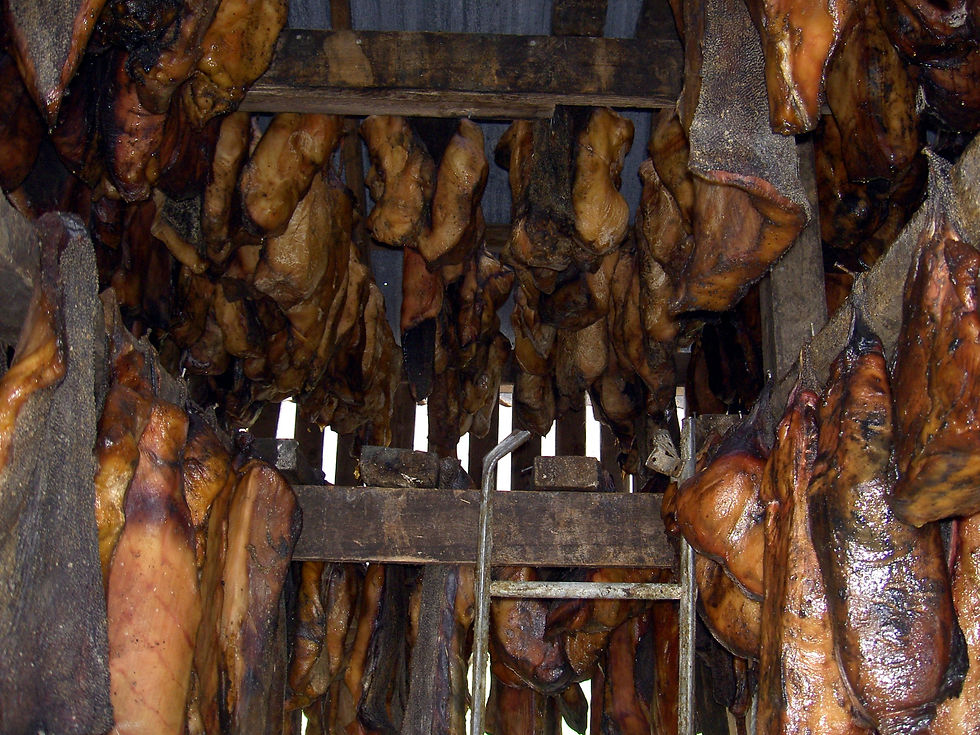
After fermentation, the meat was taken out, cut into smaller pieces and hung in drying sheds. The drying itself could take additional weeks or months.
Modern production is more hygienic and controlled, but the basic principle remains remarkably similar:
Fermentation. Drainage. Drying.
And finally, small pieces of meat served as an Icelandic “delicacy.”
What Actually Happens to the Meat?
What makes hákarl fascinating is that what looks like ordinary “rotten meat” is actually a fairly complex biological process.
In 2023, scientists closely examined what happens to microorganisms and chemical compounds during fermentation.
They found, for example, that TMAO decreases dramatically during the process and can fall below the detection limit after roughly five weeks. At the same time, the amounts of trimethylamine and dimethylamine increase, while the pH rises from around 6 to around 9.
So hákarl production is not simply:
“Let’s let the shark rot.”
It is fermentation, during which microorganisms gradually change the chemical composition of the meat.
And yes, the result is an aroma that most visitors to Iceland are unlikely to confuse with anything else.

“That’s Not a Smell. That’s an Aroma!”
I first heard about hákarl from my Icelandic acquaintance Haegir, and I have to say, he defended it fiercely.
When I mentioned that fermented shark had a reputation for being truly disgusting, Haegir strongly disagreed.
“That’s not a smell. That’s an aroma!”
Haegir was actually the reason I decided I had to try it.
Later, while shopping at Nettó, I happened to spot a small box in the refrigerated section with the mysterious name Hákarl.
So this was it.
This had to be that taste of Iceland that had been part of the country for centuries. Surely I couldn’t just leave it sitting there.
I had to try it.

At the checkout, the cashier suddenly stopped while scanning it.
He looked at the package.
Then at me.
And asked:
“Do you know what that is?”
I nodded.
That afternoon, my friends and I went out onto the balcony. We didn’t want to stink up the entire hostel.
One of my friends stayed in the doorway so he could escape inside if necessary.
He didn’t make it.
I opened the lid and he vomited within the first second.
I have to say, I had never smelled anything quite so intensely fishy and ammoniacal in my life.
Maybe even blowflies would have vomited.
Haegir would certainly have objected:
That’s not a smell. That’s an aroma.
It Tasted Exactly the Way It Smelled
And then came the moment.
I have to admit that, despite my disgust, I took one piece and put it in my mouth.
It tasted exactly the way it smelled.
Strongly fishy, sharp and strangely ammoniacal.
And then there was something else.
The texture.
The fermented shark meat reminded me of something between meat and chicken cartilage.
And I really hate chicken cartilage.
I didn’t vomit.
But I also couldn’t swallow it.
So my first attempt at tasting one of Iceland’s most famous specialties ended with me tasting hákarl – but not actually swallowing it.
“Then Find Another Cuisine”
Of course, not all Icelanders love hákarl.
One person who certainly did not was Anna Kristine Magnúsdóttir, my Icelandic friend and a journalist.
Once, I jokingly told her that I would happily eat fried hákarl.
Her reaction was immediate:
“Brrr, then find another cuisine.”
And I actually understand her.
You don’t have to love hákarl just because it is Icelandic.
Just as some people love fermented cheeses, olives or raw fish while others feel sick at the smell, hákarl is simply a matter of taste.
Or perhaps of courage.
A Few Years Later, There Was a Second Chance
I thought my career as a hákarl taster was over.
But several years later, I was travelling around Iceland with three friends – Lea, Silva and Filipa.
I told them my story, and they insisted that they had to try it too.
We were staying in an old hospital in Seyðisfjörður.
After we opened the package, however, the women quickly lost their courage. The hákarl had been taken outside with us even before we opened it.
A short while later, as they struggled to keep the contents of their stomachs where they belonged, an elderly Icelandic man walked past.
He stopped.
He sniffed the air.
Looked at the box.
And suddenly his face lit up.
“Oooo, hákarl! We love it!”
We gave him the entire box.
He tipped the whole contents into his palm and swallowed it like a hungry dog.
Then he looked at us and happily added:
“Wow, it is mild!”
Mild.
For us, it was something capable of turning our stomachs within seconds.
For him, almost nothing.
Hákarl Is Still Alive
It might seem that hákarl is now nothing more than a tourist attraction.
It isn’t.
Icelanders still eat it.
Just not nearly as much as they did in the past.
Modern Iceland has completely different food supplies, and hákarl is no longer something a family depends on for survival. Today, it is more of a delicacy associated with traditional occasions, especially during the winter festival of þorrablót.
Its meaning has therefore changed.
What was once a practical way to preserve available meat has become a piece of Icelandic cultural memory.
And that is why it has survived.
It Is Still Made on Snæfellsnes
If you are travelling around Snæfellsnes, you may encounter hákarl before you ever taste it.
On the northern side of the peninsula lies Bjarnarhöfn, where a family has continued the traditional processing of Greenland shark for generations. According to the family, its connection to the trade dates back to 1608.
Today, hákarl is still produced there, and the site also has a museum dedicated to sharks and this unusual Icelandic tradition.
And this is where the whole story takes on another dimension.
When you drive past Bjarnarhöfn, under the right conditions you may notice the distinctive aroma before you even see the processing facility.
You can smell the shark.
The site has traditional drying sheds, and visitors can see how fermented shark is processed. The entire process takes several months, including fermentation and subsequent drying.
Suddenly, you realize that hákarl is not just a little package that a tourist buys in a supermarket to entertain friends in the evening.
Someone actually has to make it.
Someone has to process the shark, ferment it, dry it and eventually cut it into pieces.
And on Snæfellsnes, that is still happening.
From Survival Food to Icelandic Tradition
Perhaps the most fascinating part of the hákarl story is how its meaning has changed.
Once, it was practical food.
People had to use what the sea provided and preserve it for times when there might be nothing else.
Today, an Icelander can walk into a supermarket and buy fresh meat, fish or practically anything else.
And yet hákarl is still being made.
Not because people need it to survive, but because some foods gradually become part of a culture’s identity.
Hákarl is exactly that.
It is a taste of the past.
And a very powerful reminder of what life in Iceland once looked like.
So Why Do Some Icelanders Still Eat It?
Perhaps because food is not just about taste.
It is also about memory.
About tradition.
About what your parents and grandparents ate.
Hákarl is a reminder of a time when Iceland did not have today’s supply chains, freezers and supermarkets filled with fresh food.
There was seawater, wind, cold and the need to survive on whatever was available.
Fermentation made it possible to use meat from an animal that could not safely be eaten fresh.
From today’s perspective, that may be far more fascinating than the smell itself.
Hákarl was not created to shock tourists.
It was created so that people could eat shark.
And Then You Open the Box
Today, hákarl is one of those foods tourists try simply so they can say:
Yes, I tried it.
Some swallow it.
Some spit it out.
Some vomit.
And some even come back for more.
I am somewhere in between.
I have tried hákarl.
Once.
Then again.
But if someone asked me whether I wanted it for dinner, I would probably remember Anna Kristine.
“Brrr. Then find another cuisine.”
And perhaps this time, I would listen.
Because Iceland has plenty of flavors that you can fall in love with.
Hákarl is not one of them for me.
But that is exactly why I am glad I tried it.
Because when you look past the tourist shock, hákarl is not simply a smelly shark in a plastic box.
It is a story more than six centuries old about how people learned to survive in one of the harshest countries in Europe.
And if you ever drive across Snæfellsnes and smell something in the air that reminds you of old fish and ammonia, you may already know what it is.
That’s not a smell.
That’s an aroma.

About the Author
Iceland has fascinated me for many years. Over the course of numerous journeys across the island, I have driven tens of thousands of kilometers, experienced storms that changed travel plans within minutes, and witnessed days when choosing the right route meant discovering places that most visitors never see. I documented many of these experiences in my documentary film Island in the North.
Through this website, I share practical travel advice, up-to-date information, and firsthand experiences from the field to help others explore Iceland more safely and gain a deeper understanding of its unique landscapes and ever-changing nature.


Komentáře