
ICELAND SOLAR ECLIPSE 2026: ROAD CLOSURES, ONE-WAY ROADS AND POLICE MEASURES

The total solar eclipse on August 12, 2026, will be far more than an astronomical event for Iceland. Authorities expect an unprecedented influx of visitors and have already released a detailed plan covering traffic management, public safety, and emergency services. The most significant measures will affect West Iceland, particularly the Snæfellsnes Peninsula and the Westfjords, where totality will last the longest.

Iceland Eclipse Roads: Controlled Traffic on Iceland's Roads
Authorities openly warn that traffic volumes will be significantly higher than during a normal summer tourist season. As a result, some roads will operate as temporary one-way routes, while others will have traffic restrictions and reduced speed limits.

On the Snæfellsnes Peninsula, a temporary one-way system will be introduced on Útnesvegur (Route 574) from Búðir toward Hellissandur beginning at noon on August 12.
The speed limit will be reduced to 50 km/h (31 mph), and depending on traffic conditions, access may also be restricted for large buses and motorhomes. These measures are intended to keep traffic flowing safely while ensuring emergency vehicles can reach any incident quickly.
Similar arrangements will be introduced in the Westfjords, where Örlygshafnarvegur (Route 612) and Rauðasandsvegur (Route 614) will also operate under controlled traffic. After totality ends, traffic will be directed back along the same designated routes to help prevent major congestion.
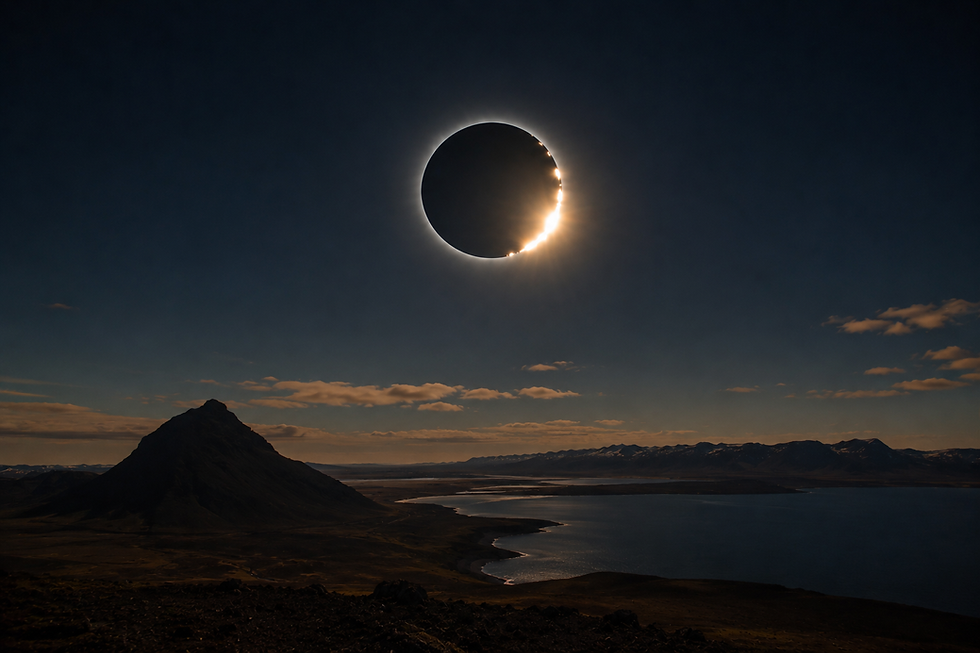
The video shows how the shadow of a solar eclipse passes over western Iceland. Source: youtube.com/@icelandatnight
Traffic Management Maps
Authorities have published official traffic management maps showing the planned one-way systems and road controls across western Iceland for August 12, 2026.
Snæfellsnes – Official traffic management map published by Vegagerðin for the total solar eclipse on Westfjords (Patreksfjörður–Látrabjarg area) – Official traffic management map published by Vegagerði Dalabyggð – Official traffic management map published by Vegagerðin for the total solar eclipse on 1 Vatnsleysuströnd – Official traffic management map published by Vegagerðin for the total solar eclip Miðnes (Keflavík–Garður–Sandgerði–Hafnir) – Official traffic management map published by Vegagerðin
SOURCE: www.vegagerdin.is
Parking on Roadsides Will Be Strictly Prohibited
Icelandic authorities also emphasize that stopping or parking on roads or road shoulders will be strictly prohibited.
Visit Westfjords states:
"Parking on the road or road shoulders is strictly prohibited. Vehicles parked illegally may be removed at the owner's expense."
The reason is straightforward: Iceland's narrow rural roads must remain clear for ambulances, fire services, police vehicles, and rescue teams.
Find everything you need to know about the solar eclipse in Iceland HERE.
Police Will Be Managing Traffic, Not Just Monitoring It
Unlike a normal tourist season, Icelandic police will play a much more active role during the eclipse.

According to official plans, the following personnel will be deployed throughout the affected regions:
Police officers
Search and Rescue teams
Firefighters
Medical personnel
Rangers responsible for protected natural areas
Their role will extend far beyond responding to emergencies. They will actively direct traffic, regulate access to popular viewing locations, and ensure emergency routes remain open at all times.
Visitors are therefore urged to follow all instructions given by police officers and traffic controllers.
Authorities' Advice: Arrive Early, Stay Late
Virtually every official information source repeats the same recommendation:
"Arrive early, stay late, and come prepared."
Authorities expect the greatest traffic problems to occur after totality, when thousands of visitors attempt to leave simultaneously.
Instead of departing immediately after the eclipse, visitors are encouraged to remain in the area for several hours before beginning their journey home.
Infrastructure Will Be Under Significant Pressure
Officials openly acknowledge that services in remote parts of western Iceland are limited.
Visitors should be aware that:

parking areas have limited capacity;
some locations may be closed once full;
services outside larger towns are extremely limited;
emergency assistance in remote areas may take considerably longer than usual.
Authorities therefore recommend bringing:
sufficient food;
drinking water;
warm clothing;
any necessary medications;
and ensuring your vehicle has a full fuel tank—or, if driving an electric vehicle, a fully charged battery—before entering the region.
What About Toilets?
Perhaps surprisingly, this has become one of the most practical topics in the eclipse planning process.
Authorities recommend using designated gathering sites, where visitors will find parking areas together with basic facilities.
Many remote viewing locations offer no services whatsoever, and visitors are expected to plan accordingly.
Current official plans do not mention the widespread installation of portable toilets along the eclipse path. However, portable facilities are expected to be available primarily at major official gathering sites and parking areas—not along roadsides or at isolated viewpoints.
Practical Advice for Visitors
If you think you may need restroom facilities during the day, it is worth planning several hours ahead.
Authorities recommend:
using toilets at campsites, petrol stations, or towns before driving to your viewing location;
using only official restroom facilities at designated sites;
never stopping on roads or road shoulders for this purpose;
avoiding entry onto private land.
Iceland has long struggled with environmental damage caused by mass tourism, and protecting the country's fragile landscapes will be one of the authorities' highest priorities during the eclipse.
Visitors should therefore expect police officers and park rangers to enforce these regulations strictly.
Recommended Viewing Sites with Visitor Facilities
Location | Recommended Viewing Site | Facilities | Notes |
Hólmavík | Arngerðareyri (near the airport) | Parking, toilets, nearby services | Official viewing location |
Bolungarvík | Bolafjall | Shuttle bus, toilets | No private vehicle access to the summit |
Bolungarvík | Campsite | Parking, toilets | Alternative site with better facilities |
Þingeyri | Sports Centre & Swimming Pool | Parking, toilets | Good local services |
Suðureyri | Sports Centre | Parking, toilets | Official gathering site |
Ísafjörður | Safnahúsið Museum | Parking, toilets, fuel, restaurants | Largest town in the region |
Ísafjörður | Torfnes Sports Centre | Parking, toilets | Large visitor capacity |
Flateyri | Sports Centre | Parking, toilets | Official gathering site |
Bíldudalur | Baldurshagi | Parking, toilets | Visitor facilities available |
Tálknafjörður | Sports Centre & Campsite | Parking, toilets, camping | Suitable for motorhomes |
Patreksfjörður | Community Centre & Campsite | Parking, toilets, camping, fuel | One of the main recommended viewing areas |
Súðavík | Raggagarður | Parking, toilets | Smaller official viewing site |
ZDROJ: https://www.westfjords.is
What Do These Sites Have in Common?
Authorities recommend these official gathering sites because they generally provide:
toilet facilities;
parking;
waste disposal;
nearby cafés, restaurants, or shops;
fuel stations within reasonable distance;
faster access to police, firefighters, and emergency medical services;
stronger mobile phone coverage than remote viewing locations.
Iceland's Largest Logistical Operation of the Summer
The official plans make one thing abundantly clear: Iceland is leaving nothing to chance.
Temporary one-way roads, controlled traffic systems, shuttle buses, increased police presence, and coordinated emergency services all demonstrate that authorities are preparing for what could become one of the largest transportation operations in the history of Icelandic tourism.
For visitors, the message is simple:
Plan carefully, follow official instructions, and expect that reaching a few unforgettable minutes of totality will require considerably more patience than an ordinary summer road trip through Iceland.
Sources
Vegagerðin (Icelandic Road and Coastal Administration) – Total Solar Eclipse 2026
Visit West Iceland – Practical Information: Solar Eclipse 2026
Visit Westfjords – Solar Eclipse 2026
SafeTravel Iceland – Solar Eclipse Travel Conditions
Almannavarnir (Icelandic Civil Protection) – Emergency Information

About the Author
Iceland has fascinated me for many years. Over the course of numerous journeys across the island, I have driven tens of thousands of kilometers, experienced storms that changed travel plans within minutes, and witnessed days when choosing the right route meant discovering places that most visitors never see. I documented many of these experiences in my documentary film Island in the North.
Through this website, I share practical travel advice, up-to-date information, and firsthand experiences from the field to help others explore Iceland more safely and gain a deeper understanding of its unique landscapes and ever-changing nature.


Komentáře