
WHERE TO BUILD A FARM? LIVESTOCK MAY HAVE GUIDED ICELAND’S VIKINGS

In Iceland, finding a place with a beautiful view was not the priority. A farm needed water, grazing land, meadows for hay, fuel and protection from the weather. A single bad decision could determine whether a family survived the winter.
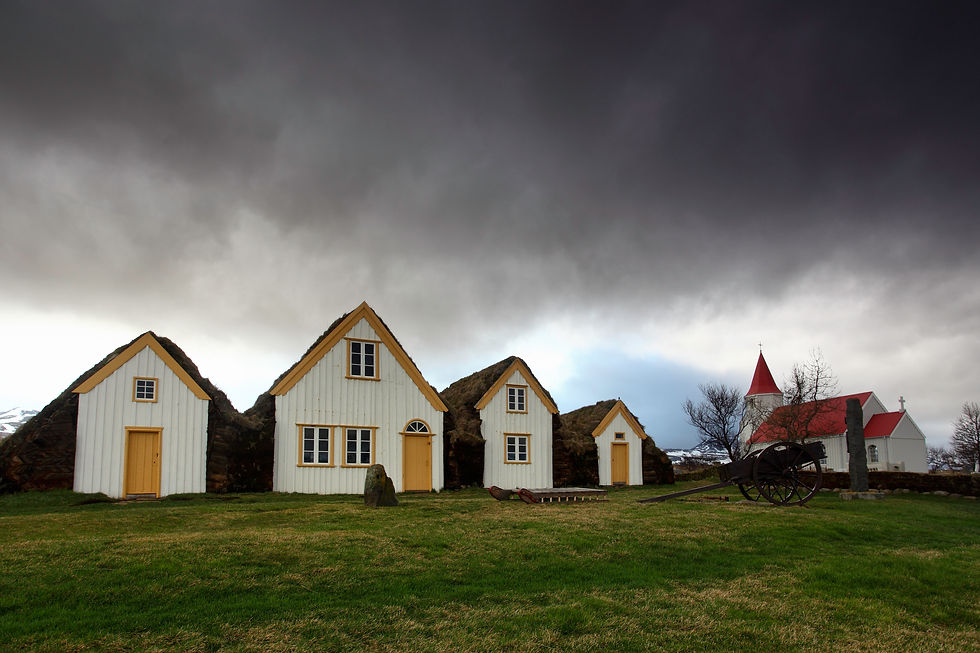
When you drive through Iceland today, you may get the impression that some farms stand in the strangest possible places. One is squeezed between a mountain and the sea, another lies deep in a valley, while yet another stands in the middle of a vast green plain.
For a modern person, choosing a location is a matter of roads, electricity, internet access or the distance to the nearest town. For Iceland’s first settlers, however, the question was much more fundamental: Can this place sustain us?
And the answer was hidden primarily in the grass.
First the hay, then the house
When Norse settlers established themselves in Iceland during the settlement period, their economy was based largely on livestock farming. And livestock needed feed through the winter.
Hay production was therefore one of the key factors determining the success of early Icelandic farms. Archaeological and environmental research shows that so-called home fields – intensively used areas immediately surrounding a farm – were used, among other things, to produce hay for overwintering livestock.
This changes the way we should look at an Icelandic farm. It was not simply a house built somewhere in a pasture. It was an entire system. A farmer needed land with enough grass for grazing, while also being able to produce enough hay for the months when the animals could not stay outside.
A good meadow could therefore be more valuable than a large field.
Inside, there was far less space than you might expect
Once you step inside, Glaumbær seems almost the opposite of what it looks like from the outside. The extensive complex of thirteen buildings turns into narrow passageways, small rooms, low ceilings and surprisingly cramped living quarters. Each section had its own purpose – there was a kitchen, pantry, storage space, guest rooms, a workshop and a communal living room known as the baðstofa.

The baðstofa was the heart of the house. People slept, ate, worked, repaired clothing and spent most of their time there during the long Icelandic winter. Food was prepared in the kitchen and stored in pantries before being brought into the communal room. People often ate sitting on their beds.
To a modern visitor, the space can feel almost claustrophobic. But the small rooms had a purpose. Iceland was a country with little timber and long, cold winters. Thick turf walls protected people from wind and cold, while smaller rooms meant less space that had to be kept warm. Different functions were therefore not concentrated in one large building but divided among several small interconnected spaces.
Comfort was certainly not the priority. Privacy was minimal, light was scarce and everyday life took place in close proximity to other members of the household.

In the baðstofa, for example, beds were arranged along the walls, and the room served simultaneously as a bedroom, living room and workspace. The surviving baðstofa at Glaumbær covers approximately 52 square metres, and its low ceiling was designed so that people could sit comfortably, but could not stand upright everywhere.
Glaumbær demonstrates one important thing: an Icelandic farm was not built for comfort. It was built for survival. Every metre, every wall and every room had a practical purpose.

Water was just as important
Hay was not the only consideration. A farm needed water for people and animals, grazing land, suitable soil and, if possible, access to sources of materials and fuel.
Location also played an important role. Valleys, lowlands and coastal areas offered a combination of grassland, water and access to other resources. By contrast, some higher-altitude locations proved too demanding for long-term farming.
Research into early Icelandic settlements shows that farmers had to respond even to very small differences in soil and microclimate. A few hundred metres could mean different soil quality, different moisture levels or different hay yields.
So choosing a location was certainly not simply a matter of asking:
“Is there enough grass here?”
It was more like asking:
“How much hay can we produce here every year, and will it be enough to survive the winter?”
The legend of the herd that lies down
You may already have heard the Icelandic story that people were supposed to watch their animals when choosing a site. Where the herd lay down was supposedly the best place to build a farm.
It sounds perfectly logical.
Animals can identify places with good grass, where the ground is not too wet, where the microclimate is more pleasant and where they can rest comfortably.
But this is where a charming tradition needs to be separated from what we actually know.
There is no clear historical evidence that the first Icelanders followed a fixed rule of “build your farm where the herd lies down.” Archaeological research does, however, point to something similar in principle: soil quality, microclimate, water, grazing and especially hay production were crucial when choosing and using the landscape.
The story of the herd may therefore reflect an old practical experience, but it should not be presented as a documented Viking method.
A farm was not just one place
Another interesting aspect is that the farm’s resources were not limited to the immediate surroundings of the house.
For centuries, Icelandic agriculture also made use of sel, seasonal pastures and shelters known in English as shielings. During the summer, people moved animals there for grazing, freeing the land around the main farm for hay production.
Research at the Helgusel site in southwestern Iceland, for example, has shown that grazing was taking place there as early as around AD 950. Later, a seasonal settlement developed there as part of a broader system of landscape use.
In other words, a good farmer did not use the landscape randomly. Different areas were allocated according to what they were best suited for.
One area served as pasture, another as a hay meadow, while another might be used seasonally.
Why Icelandic farms did not always survive
Iceland’s landscape was not an easy one to farm.
The first settlers arrived in a country that was partly wooded, but which also had limited agricultural potential. As livestock farming intensified, the landscape began to change.
Grazing gradually affected vegetation and in some areas contributed to erosion. Research at Helgusel, for example, has recorded a decline in woody vegetation associated with grazing, followed by increased erosion.
Some farms therefore prospered for generations, while others were abandoned.
Archaeologists can today identify abandoned farms in the Icelandic landscape from the remains of buildings, enclosures and former hayfields. In some valleys, old boundaries of hay meadows and other traces of agricultural use are still visible.
The landscape itself still preserves a map of how people once farmed it.
And what would determine the location today?
Modern Icelandic farmers obviously face very different challenges. Agriculture is nevertheless still closely linked to livestock farming. According to Statistics Iceland, livestock farming and animal products accounted for approximately 66 percent of the value of Icelandic agriculture in 2024. Crop production accounted for around 26 percent.
Today, farms mainly raise sheep and cattle, as well as horses and other animals. Crops include forage and barley, potatoes and other produce. Thanks to geothermal energy, Iceland also has highly distinctive conditions for growing vegetables in greenhouses.
The number of agricultural enterprises, however, has declined over recent decades. In 2024, 2,442 operating enterprises were recorded across five monitored agricultural sectors, 17 percent fewer than in 2008.
A modern farm still needs good land, water and feed. But roads, electricity, machinery, operating costs and access to markets have now been added to the equation.
The Viking was looking for a place where the herd could survive
So when you drive past an Icelandic farm today, you are looking at the result of a very old decision.
Why here?
Because there was water here. Grass grew here. Hay could be harvested here. Animals could graze here. A house could be built here, and there were enough resources to support a family.
The first Icelanders did not choose a farm site for the view. They chose it according to whether it could sustain them.
And perhaps that is why the story of the herd lying down in the best place has such staying power.
It may not be an accurate description of a Viking farming method. But it perfectly captures the logic of life in Iceland: first you had to find a place where the animals could thrive. Only then could you think about the house.
Sources
National Museum of Iceland – information on historic turf farms and their architecture.
Skagafjörður Heritage Museum – Glaumbær – Glaumbær’s construction, building materials and traditional building methods.
University of Iceland – Turf Building in Iceland: Past, Present, and Future – research on the development of turf building in Iceland.
Visit North Iceland – Turf Houses – overview of the development of Icelandic turf houses.

About the Author
Iceland has fascinated me for many years. Over the course of numerous journeys across the island, I have driven tens of thousands of kilometers, experienced storms that changed travel plans within minutes, and witnessed days when choosing the right route meant discovering places that most visitors never see. I documented many of these experiences in my documentary film Island in the North.
Through this website, I share practical travel advice, up-to-date information, and firsthand experiences from the field to help others explore Iceland more safely and gain a deeper understanding of its unique landscapes and ever-changing nature.


Komentáře