
ICELAND 2026: TIPS BEFORE YOU PACK YOUR CAMERA FOR THE AUGUST 12 ECLIPSE

In less than two months, thousands of photographers will travel to Iceland to witness one of the most remarkable astronomical events of this decade – the total solar eclipse on August 12, 2026. Many will arrive with expensive gear, long telephoto lenses, and carefully prepared equipment checklists. Yet it is quite possible that the best images will ultimately be taken by people holding nothing more than a mobile phone.

It sounds like a paradox, but anyone who has spent time photographing or filming in Iceland knows that success here does not depend solely on equipment. It is primarily determined by the ability to react to conditions that can change within minutes.
If you are planning to photograph the eclipse in Iceland, these five mistakes may determine how your experience turns out.
1. Too much equipment
It is tempting to be prepared for everything. An eclipse feels like a once-in-a-lifetime opportunity, and many people feel they must bring everything they own.
The result often looks the same: a heavy backpack full of lenses, filters, tripods, and spare batteries. Yet during the event itself, every extra item becomes a burden that distracts your attention.
Simple equipment that you know well is often better than a complex setup you spend more time adjusting than actually observing.

2. Fixation on one location
Many people plan weeks or even months in advance to watch the eclipse from a specific waterfall, mountain, or coastline.
But Iceland does not follow plans. It only takes cloud cover over your chosen location while skies are clear just a few kilometers away.
The best experiences and photographs often belong to those willing to change location at the last minute.
In Iceland, the tripod is not the most important tool. The ability to move is.
3. Ignoring the weather during the August 12 eclipse
Icelandic weather is changeable and not always predictable.
Forecasts are a useful tool, but not a certainty. Conditions can change within hours, sometimes even minutes.
Follow weather developments, but do not rely on a single morning model. A location that looks hopeless may be under clear skies in the afternoon—and vice versa.
Patience and flexibility are often more important than luck.

4. Focusing only on the Sun
Most eclipse photography guides focus on detailed shots of the Sun and its corona. That is understandable—technically, it is a fascinating image.
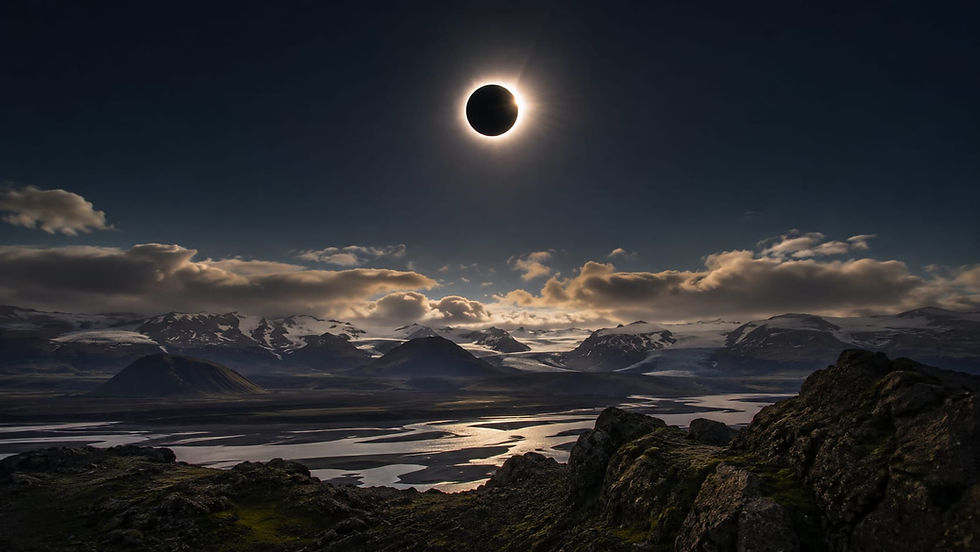
However, thousands of people around the world already have perfectly exposed images of the Sun. What makes your photo unique is not the Sun itself—it is Iceland.
A waterfall in sudden twilight. A mountain ridge fading into darkness. A coastline transforming within minutes.
The most interesting photographs often do not show the Sun itself, but the transformation of the landscape.
Quick minimum settings so your images are not just white blobs
You do not need to be a photography expert to capture the eclipse. A few basic rules are enough to prevent the worst outcome—a blown-out image with no detail.
Camera (basic guidance)
Manual mode (M), if you can use it
ISO: as low as possible (100–200)
Aperture: f/8 to f/11 as a starting point
Shutter speed: start around 1/1000s and adjust as needed
Always use a solar filter during partial phases
👉 Goal: not “perfect settings,” but avoiding an overexposed white disc.
Mobile phone
Enable Pro / manual mode if available
Reduce exposure manually (slider down)
Do not rely on automatic settings
During partial phases, do not shoot without a filter
👉 With phones, underexposing is more important than trying to capture detail.
Important reality: Most bad eclipse photos are not caused by bad lenses, but by automatic overexposure. A simple rule is enough: if you are unsure, make the image darker, not brighter.
5. Spending the total eclipse behind the viewfinder
This is perhaps the most common mistake.
Totality during the August 12 eclipse will last only a few minutes. After months of preparation, it is easy to fall into the urge to capture every moment. But while you are watching the screen, you may miss the most important part of the event.
Photos will remain. The experience will not. Take your shots. Record a video. And then put the camera down for a moment.
The change in light, sudden darkness, people’s reactions, and the corona itself are things no equipment can fully capture.
Final thought
Many people come to Iceland to bring back photographs of a solar eclipse. But perhaps it is worth coming for the experience itself. The photos will follow.
And if the weather does not cooperate, you may still take home something more valuable than any image—a memory of one of the rarest natural phenomena in one of the most dramatic landscapes in the world.

About the Author
Iceland has fascinated me for many years. Over the course of numerous journeys across the island, I have driven tens of thousands of kilometers, experienced storms that changed travel plans within minutes, and witnessed days when choosing the right route meant discovering places that most visitors never see. I documented many of these experiences in my documentary film Island in the North.
Through this website, I share practical travel advice, up-to-date information, and firsthand experiences from the field to help others explore Iceland more safely and gain a deeper understanding of its unique landscapes and ever-changing nature.


Komentáře